
Stacked Stone vs. Stucco: 7 Facts That Decide Your Facade
Two houses on the same street can wear two completely different skins, and both look right. One has the deep shadow lines of stacked stone across the entry; the next reads as one smooth, uniform plane of stucco. Both finishes cover a wall, protect the structure behind it, and set the tone for everything else. They get there in almost opposite ways, and the choice between them shapes maintenance, moisture handling, and how the front of the home ages for decades.
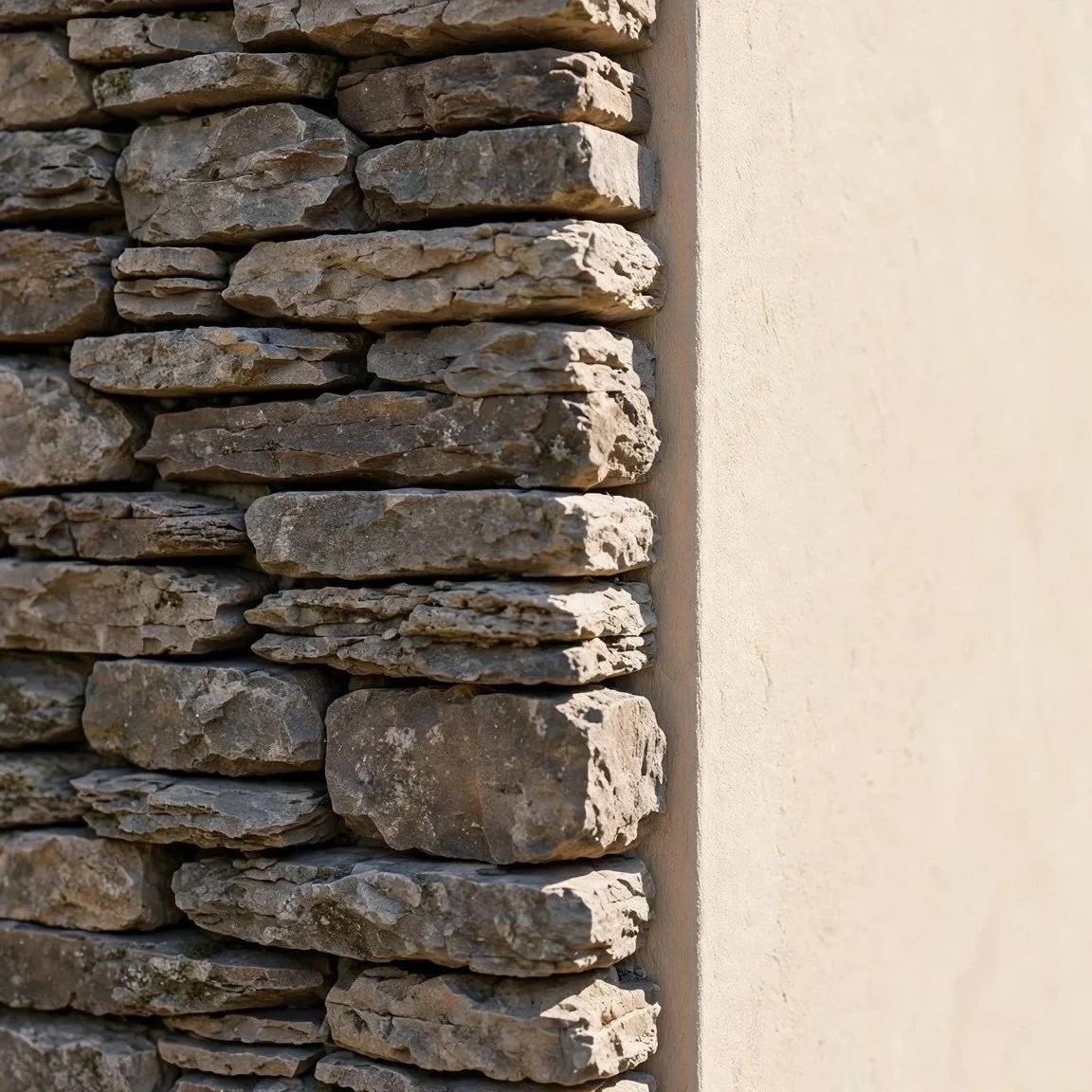
What Stacked Stone Veneer Actually Is
Stacked stone veneer is a thin stone facing applied over a wall rather than a load-bearing wall built from full-depth blocks. The pieces are cut or cast to a shallow thickness, then set in courses so the faces stack tightly with minimal visible mortar. The result is dimension: real depth, real shadow, and a surface that changes as light moves across it through the day.
There are two families, and they behave differently.
Natural stone veneer is quarried rock, sawn to a workable thickness. Slate, quartzite, granite, and limestone are common. Every piece carries its own color and grain, so a natural wall never repeats a pattern. Because it is real stone, it resists fading and holds up to abrasion, though the weight per square foot runs higher and each piece needs more fitting.
Manufactured stone veneer is a molded, pigmented concrete product cast from molds taken off real stone. It weighs less, arrives in a consistent range of shapes, and installs faster because the pieces are lighter to handle and easier to trim. The color is integral to the casting, so a scratch shows the pigment rather than raw gray. The trade-off is that the coloring, while convincing, is applied by a manufacturer and can vary batch to batch, so ordering enough from one production run matters.
Both types are heavy finishes that hang on the wall, which is why the wall behind them has to be built to carry the load and shed water.
What Stucco Actually Is
Stucco is a plaster coating, a mix of cement or lime, sand, and water, troweled onto a wall in layers and allowed to cure into a hard, continuous shell. Instead of many small pieces, you get one monolithic surface that wraps the whole plane. Texture comes from how the final coat is floated or dashed: smooth, sand-float, lace, or a heavier dash finish.
Stucco comes in more than one system, and the differences matter for durability.
Traditional three-coat stucco is the classic build: a scratch coat pressed into metal lath, a brown coat that builds thickness and flatness, and a finish coat that carries the color and texture. The lath and the layered thickness give it strength and a long service record.
One-coat stucco compresses that into a single thicker application over a fiber-reinforced base, often with a foam board behind it for insulation. It goes up faster and can perform well when detailed correctly, though it depends heavily on the installer getting the base right.
EIFS is a separate system, not stucco at all in the strict sense. It is an exterior insulation and finish system: foam insulation board bonded to the wall, a reinforcing mesh, and a thin synthetic finish coat troweled over it. It looks like stucco and insulates better, but it manages water differently and lives or dies on its flashing and drainage details. Confusing EIFS with cement stucco is a common mistake, and the two are maintained differently.
Appearance and Texture
This is where the two finishes separate most clearly.
Stacked stone is about relief and variation. The courses cast shadows, the colors shift across the wall, and no two square feet look identical. It reads as substantial and grounded, which is why it tends to anchor the parts of a home you want the eye to land on: the entry, a chimney, the base of the elevation. Up close, the seams and edges are part of the character.
Stucco is about calm and continuity. One color, one texture, one uninhabited plane that lets the architecture, the windows, the rooflines, the massing, do the talking. It can be tinted almost any color and finished from glass-smooth to heavily textured. Where stone draws attention, stucco recedes and unifies.
A useful way to think about the pairing: stucco is the quiet backdrop and stone is the statement hung against it. That is exactly why so many facades combine them rather than pick one.
Durability and How Each Handles Moisture
Both finishes can last for decades, and both fail the same way when water gets behind them and cannot get out. The wall assembly matters as much as the finish itself.
Stacked stone is extremely hard at the surface and shrugs off impact and abrasion. Natural stone in particular is close to inert. The vulnerability is not the stone; it is the mortar joints and the water-resistive barrier behind the veneer. Stone veneer is usually installed as a drainage system: a weather barrier, a drainage gap or mesh, lath, and a mortar scratch coat, so any water that migrates behind the stone can run down and weep out at the bottom. When that drainage plane and its flashing are done right, the wall stays dry. When they are skipped, moisture is trapped against the sheathing.
Stucco is a hard shell, and its main enemy is cracking. Cement-based finishes are rigid, so they move with the building. Hairline cracks from normal settlement and thermal cycling are common and mostly cosmetic, but a crack that opens up becomes a path for water. Good stucco relies on control joints, proper lath, and a weather-resistive barrier underneath so the wall can drain. On any climate angle, the stress is two-sided: cold and freeze-thaw can widen a crack in winter, and repeated heat and thermal expansion work the same joints the rest of the year, so the detailing has to account for movement year-round, not just one season.
The honest comparison is that neither finish is waterproof on its own. Both are cladding over a drainage assembly, and the quality of the flashing, weather barrier, and joints decides whether they last.
Maintenance Over the Years
The upkeep rhythms are different, and knowing them ahead of time avoids surprises.
Stone veneer is low-touch but not no-touch. Natural stone benefits from periodic sealing to resist staining and to slow water absorption, especially on more porous stones. The mortar joints are the part that needs an occasional eye: a cracked or loose joint should be repointed before water uses it as a door. Cleaning is usually a gentle wash; harsh pressure can drive water into the joints.
Stucco is patch-and-paint maintenance. Hairline cracks get filled, control joints get checked, and the surface may be recoated or repainted over time as color fades or fine cracks accumulate. A skilled patch on a textured stucco wall has to match the surrounding texture, which is its own small craft. Done regularly, the upkeep is minor; ignored, small cracks become the entry point for the moisture problems above.
Where Each One Fits on a Home
Neither finish is the "right" one everywhere. They earn their place in different roles.
Stacked stone shines as an accent. A stone entry surround, a wainscot along the base of the elevation, a stone-wrapped column or chimney, or a single feature wall gives a home texture and weight exactly where you want emphasis. Running stone across an entire large elevation is possible, but the weight and labor climb quickly, so most designs use it deliberately rather than everywhere.
Stucco is the workhorse for large, continuous surfaces. It covers broad walls efficiently, wraps curves and arches that stone cannot follow easily, and gives a coherent field color to the whole home. As the primary skin with stone accents layered on top, it is one of the most common and flexible facade strategies.
For most homes, the smart move is not either/or. Stucco handles the bulk of the wall area and the stone is placed where the eye lands, which also keeps the heavier material concentrated where it delivers the most visual return.
Installation and Substrate Needs
Both finishes depend entirely on what is behind them, and both are full-wall projects for a professional.
Stone veneer needs a wall built to carry weight and drain water: sheathing, a code-compliant weather-resistive barrier, often a drainage mat, metal lath, and a mortar scratch coat before the stone ever goes up. Larger natural stones may need extra support. Getting the flashing right at windows, doors, and the base of the wall is what keeps the assembly dry, and that detailing is unforgiving of shortcuts.
Stucco needs proper lath, control and expansion joints placed to manage movement, and the same weather-resistive barrier and flashing discipline. The number of coats and the cure time between them affect the final strength, and rushing the cure invites cracking.
A homeowner can reasonably assess a wall, plan a small accent, or handle a minor patch. Cladding a full elevation, cutting in flashing, and setting lath is a job for an experienced installer, both because the material is heavy and because a moisture detail done wrong shows up as rot years later, hidden until it is expensive. If you are weighing the two, a good next step is choosing the material and quantity with a supplier who can match color, texture, and coverage to your specific walls, then bringing in a qualified installer for the assembly.
Frequently Asked Questions
Can I install stacked stone veneer directly onto existing stucco?
Sometimes, but not automatically. A sound, well-bonded stucco wall can serve as a base for manufactured stone if it can carry the added weight and the surface is scratched or coated to give mortar something to grip. The installer will check the existing wall's attachment and often add a bonding coat or lath. On a weak or hollow-sounding stucco surface, the stone is set on new lath instead.
Does manufactured stone veneer fade faster than natural stone in strong sun?
The pigments in quality manufactured stone are engineered with UV-stable colorants and integral coloring, so fading is slow, but over many years a color shift is more likely than with quarried stone, which carries its color all the way through the rock. Choosing lighter, multi-tone blends hides any gradual change better than a single flat dark color.
What causes the brown streaks or stains sometimes seen running down a stucco wall?
Those are usually efflorescence or dirt tracking from a failed flashing or a clogged weep. Efflorescence is a whitish mineral deposit left when water moves through the cement and evaporates at the surface, carrying salts with it. Persistent staining points to a water source above, a leaking window head, or a missing kickout flashing at a roof-wall junction that needs correcting rather than just washing.
How thin is thin stone veneer, and does that affect strength?
Cut natural veneer is commonly around one inch or less in profile, and manufactured pieces are often lighter still. The thinness reduces weight so the wall can carry it, and it does not weaken the finished surface because the stone is supported continuously by the mortar bed behind it rather than spanning anything on its own.
Can stucco be applied over a wood-frame home, or only masonry?
It works over both. On wood framing, stucco is applied over a weather-resistive barrier and metal lath rather than bonded directly to the sheathing, which creates the drainage plane the wall needs. On existing masonry or block, it can bond more directly. The framing type changes the base preparation, not whether stucco is an option.
If a stone veneer joint cracks, do I have to remove the whole section to fix it?
No. A cracked or crumbling mortar joint is usually repointed: the old mortar is raked out, and fresh mortar is tooled back in to match the surrounding joints. A single loose stone can often be reset individually. Full-section removal is only needed when the failure traces back to the substrate or drainage layer behind the veneer, not the joint itself.
Compare stone and stucco samples in person before you commit — see the colors, textures, and weight for your own walls. North Valley Stone Supply LLC serves Phoenix, Scottsdale, and Tempe. Call (623) 244-8657.