
Paver Base Explained: The 8 Layers That Keep Pavers Level
A paver patio that ripples, dips at one corner, or shows a low spot where water collects rarely has a paver problem. The pavers are fine. What moved was everything beneath them. Pavers are heavy, dense units designed to sit tight against each other, and they only stay flat, level, and locked in place if the layers under them were built to carry weight and shed water. Get the base wrong, and no quality of stone will save the surface.
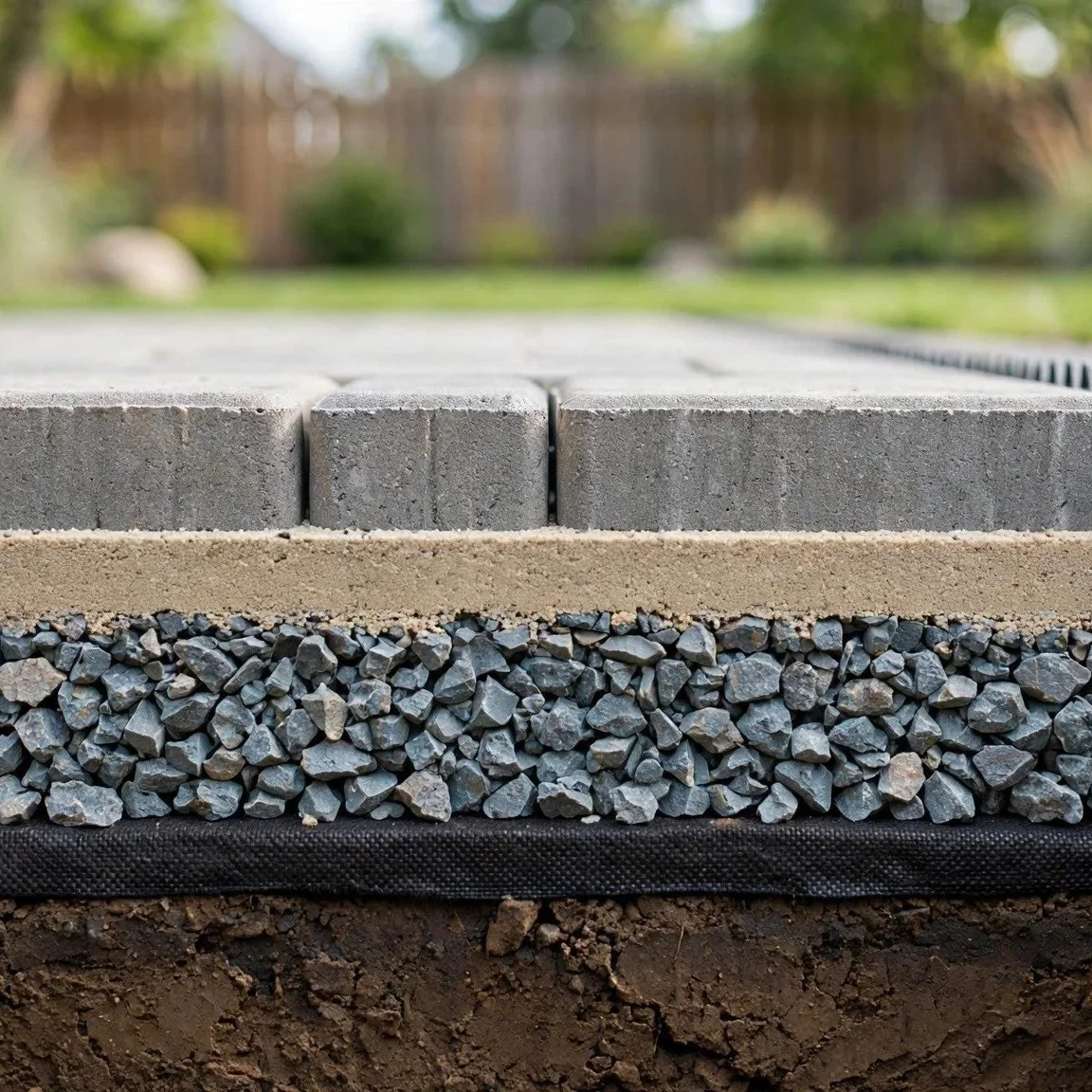
Understanding the base as a system, before touching a single paver, is what separates an installation that lasts decades from one that fails in a season or two. Each layer does one job, and each depends on the one below it.
Why Base Failures Look Like Paver Failures
When a homeowner sees a wavy walkway or a sunken patch, the instinct is to blame the pavers. They are the visible part, so they take the blame. But a paver is just a rigid unit resting on whatever supports it. If the support compresses unevenly, the paver tilts. If water washes out the material beneath, the paver drops into the void. If the perimeter has nothing holding it, the whole field creeps outward and gaps open between units.
A finished paver surface is only as stable as the weakest layer under it. A well-built base spreads the load of foot traffic, furniture, or a vehicle across a wide, compacted platform so no single point overloads the soil. A poor base funnels that same load into a few weak points, and the ground gives way in the spots carrying the most weight. This is why two patios built from identical pavers can perform completely differently: the difference is buried out of sight.
The Layers of a Proper Paver Base
Building the base means working from the ground up, and each layer has to be finished correctly before the next goes down.
Excavation and Clearing: The base starts with a hole. All sod, roots, topsoil, and organic material get stripped out, because organic matter decomposes and leaves voids that swallow the surface later. Excavation depth depends on what the surface will carry. A walkway needs less depth than a patio, and a driveway that holds a car needs the most, because heavier loads demand a thicker aggregate platform to spread them. The bottom of the excavation, called the subgrade, is graded and compacted so it starts out firm rather than fluffy.
WARNING: Before any digging, call 811 to have underground utilities located and marked. Gas, water, and electrical lines can run shallower than expected, and hitting one is dangerous and expensive. Plate compactors are heavy, and base stone comes in loads that strain backs, so treat the work as real physical labor.
Geotextile Fabric Over Soft Soils: When the subgrade is soft, silty, or holds water, a layer of geotextile fabric goes down before any stone. This woven or non-woven fabric separates the native soil from the clean aggregate above it. Without it, over years of moisture and traffic, fine soil particles migrate up into the stone and the stone works down into the soil, and the two mix until the base loses its structure. Fabric keeps the two layers doing their separate jobs. On firm, well-draining ground it is often unnecessary, which is why it is a judgment call rather than an automatic step.
The Compacted Aggregate Base: This is the structural heart of the installation. Crushed stone, often sold as road base or a dense-graded aggregate, gets spread over the subgrade and compacted with a plate compactor. Crushed material is used rather than smooth pea gravel because the angular, jagged edges interlock and lock together under pressure, forming a rigid slab that resists shifting.
The critical detail here is compacting in lifts. The stone goes down in thin layers, usually a few inches at a time, and each layer is compacted before the next is added. A plate compactor can only densify so deep, so if the whole depth is dumped at once and compacted from the top, the lower portion stays loose. That loose material settles later, and the surface drops with it. Compacting in lifts guarantees the entire depth is dense from bottom to top.
Plate compactors are heavy and throw vibration, and base stone comes in loads that strain backs. This is real physical work, and it is one reason larger or structural installs belong with a crew that has the right equipment.
The Bedding Sand Layer: On top of the compacted stone goes a thin, uniform layer of bedding sand, usually around an inch, screeded flat with a straight edge dragged across two guide rails. This is the setting bed the pavers actually rest on, and it lets each unit be tapped to its final height so the surface reads level.
The most common mistake here is making this layer too thick. Sand does not compact into a stable structure the way angular stone does, so a deep sand bed acts like a cushion that shifts and rutting appears wherever weight lands. The sand layer is a thin leveling course, not a substitute for base depth. Thin and screeded is the rule.
Edge Restraints: Pavers set tight against each other still want to spread apart at the edges, especially the outer rows with nothing beyond them. Edge restraints, plastic or metal strips staked into the base or a bead of concrete along the perimeter, hold the outermost pavers in place. Without restraints, the field slowly migrates outward, joints open, and the pattern loosens from the edges inward. Restraints are what let the whole surface behave as one locked unit instead of a loose collection of blocks.
Slope for Drainage: Water is the enemy of any base, so the finished surface is pitched to shed it. A gentle, consistent slope, commonly around a quarter inch of fall per foot, carries water off the surface and away from any adjacent structure. Pitching the surface away from a house keeps runoff from pooling against the foundation, which protects both the base and the building. The slope is set during excavation and carried through every layer, not corrected at the end.
Joint Sand and Polymeric Sand: Once the pavers are set, sand is swept into the narrow joints between them. This joint sand is what locks the units together, letting them share load side to side rather than each acting alone. Standard joint sand works, but polymeric sand contains binders that harden when misted with water, resisting washout and discouraging weeds and ants in the joints. Joints left empty let pavers rock, shift, and drift apart, so filling them is the final structural step, not a cosmetic finish.
Base Sand Versus Joint Sand: Not the Same Material
These two sands do opposite jobs, and swapping them causes trouble. Bedding sand is a coarse, sharp sand laid under the pavers as a thin leveling course. Joint sand is a finer sand swept between the pavers after they are set, to fill and lock the vertical gaps. Using fine joint sand as a bedding layer gives a soft, unstable bed. Using coarse bedding sand in the joints leaves gaps too loose to lock. Each sand is graded for its specific role, and the two are not interchangeable.
What Happens When Steps Get Skipped
Every skipped, or shortcut layer shows up eventually, usually within a couple of seasons. Skip the compaction lifts and the base settles unevenly, so the surface develops dips and low spots. Skip the edge restraints and the field spreads, opening gaps at the perimeter. Lay the bedding sand too thick and traffic carves ruts into the soft cushion. Leave the joints unfilled, and pavers rock loose and drift. Ignore the slope and water pools, and they saturate the base and wash out the fines that hold everything together. Leave organic soil in the subgrade, and it rots into voids the surface sinks into. None of these are paver defects. They are base defects wearing a paver surface, and they are why the invisible layers deserve as much attention as the stone on top.
Frequently Asked Questions
How deep should a paver base be dug out?
Excavation depth is driven by the load, not a single fixed number. A garden walkway that only carries foot traffic needs the shallowest excavation, a patio needs more, and a driveway rated for a vehicle needs the deepest cut because it must spread far heavier point loads without deforming. Soil type shifts the number too: soft or clay-heavy subgrades usually call for extra aggregate depth to compensate for weak native support.
Can I install pavers directly over concrete instead of a stone base?
Yes, an existing solid concrete slab can serve as the base in an overlay installation, since the slab already provides the rigid, load-spreading platform the aggregate would otherwise build. The catch is drainage: because water cannot pass through concrete, the slab must already slope correctly, and weep gaps or a bedding material that lets water escape at the edges are needed so moisture does not get trapped under the pavers.
Does a paver base need to cure or settle before pavers go on?
No, a properly compacted aggregate base is ready immediately, which is one advantage pavers hold over poured concrete or mortar that must cure for days. The base gains its strength from mechanical compaction, not chemical curing, so once each lift passes compaction and the surface reads firm and even, the bedding sand and pavers can go down the same day.
Why do weeds grow between my pavers if the base was built right?
Weeds in the joints rarely come from below a well-built base; they sprout from windblown seeds that land in the joint sand from above and root in the thin layer of debris that collects on any outdoor surface. This is exactly the problem polymeric sand addresses, because its hardened surface gives seeds far less to root into. Occasional sweeping and re-sanding of worn joints keeps them tight enough to stay clear.
How do I know if my existing patio's base has failed?
Watch for a low spot that holds water after rain, a section that flexes or feels hollow underfoot, joints that have widened at the edges, or a corner that sits noticeably lower than the rest. A single loose paver is often just lost joint sand and an easy fix, but a spreading pattern of dips, spreading edges, or standing water points to a base problem that needs the affected area lifted and rebuilt from the aggregate up.
Is garden weed-barrier fabric the same as the geotextile used in a base?
Not quite. Thin garden weed-barrier fabric is not engineered for the compression and shear a paver base sees, and it can tear or clog under load. True base stabilization uses a heavier geotextile rated as a separation and stabilization fabric, made to keep soil and aggregate apart under traffic for the life of the installation. Using the light weed-barrier grade under a load-bearing surface is a common shortcut that does not hold up.
Start your project on a base built to last — get quality pavers and natural stone matched to your job. North Valley Stone Supply serves Phoenix, Scottsdale, and the Valley. Call (623) 244-8657.