
What Is Polymeric Sand, and Why Do Paver Joints Need It
What Polymeric Sand Actually Is
Regular jointing sand is just graded sand poured into the gaps between pavers. It fills the space and nothing more. Polymeric sand starts from that same fine sand but blends in polymer binders, the part that changes everything. You sweep it into the joints dry, then activate it with a light misting of water. The binders wet out, react, and cure into a solid that grips the sides of each paver and knits the whole field together. Cured, it is firm to the touch and sheds water rather than soaking it up.
The useful trick is that it does not cure brittleness. A good joint stays a little flexible, so it can move a hair with the pavers as they expand in heat and contract when things cool, instead of shattering the first time the surface flexes. That combination, hard enough to lock and soft enough to give, is the whole point of the product and the reason it outlasts plain sand by years.
Think of it like grout with a shock absorber built in. Tile grout locks pieces in place, but cracks the moment anything shifts. Polymeric sand locks the pavers just as firmly, then bends slightly under the same stress that would crack a rigid filler.
What It Does That Plain Sand Cannot
Loose jointing sand has three weaknesses, and polymeric sand answers each one.
First, it holds the pavers together. Once cured, the joints act like a flexible web across the surface, so individual pavers cannot creep, tilt, or spread apart. Plain sand offers almost no lateral resistance, which is why a sand-set field slowly drifts and opens gaps over time.
Second, it resists washout. Rain running across a patio, a sprinkler head throwing water at the same joint every morning, or storm runoff sheeting over the surface will lift loose sand out of the gaps, grain by grain. Cured polymeric sand stays put through all of that because it is bonded, not just piled in.
Third, it shuts the door on weeds and ants. Weed seeds need a loose, open seedbed to root in, and ants need a workable medium to tunnel and nest. A hardened joint takes both away. Seeds have nothing to sink into, and ants have nothing to excavate, so the joints stay clean far longer than loose sand ever would.
Where It Goes and How It Is Installed
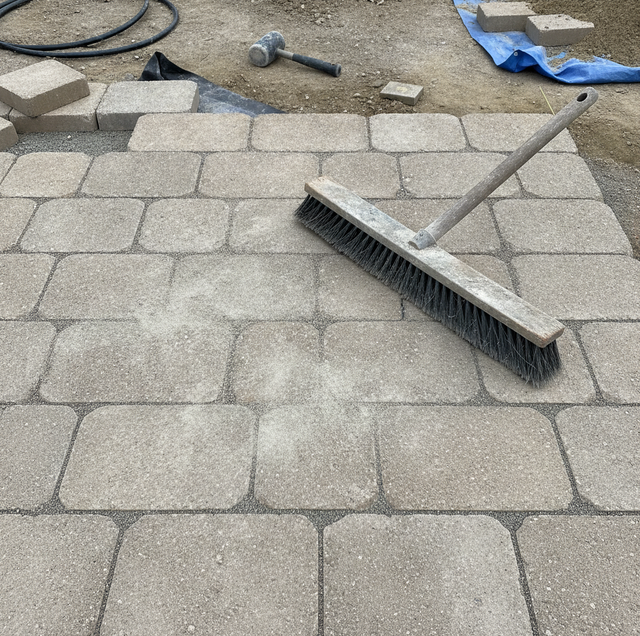
Polymeric sand lives in the joints between set pavers, and the installation is where most of the outcome is decided. The joints get swept full of the dry product to a set depth, the surface is compacted so the sand settles and packs down, then every last grain is swept and blown off the paver faces before any water touches it. Only then does the sand get activated, misted in stages so the water soaks the full depth of the joint without flooding it or blasting the sand back out. After that, it needs to cure undisturbed before it takes foot traffic or gets rained on.
Three steps make or break the job, and none of them are optional.
The joints have to be deep enough- The binders need a real column of sand to bond into. Shallow or only partly filled joints do not build enough strength, and thin fills crack and pop out within a season.
Everything has to be bone-dry when you sweep- If the pavers or the joints are damp, or if a film of sand dust is left sitting on the surface when the water goes on, the binders activate on the paver faces and leave a cloudy haze or stubborn stain that is a chore to remove. Dry pavers, dry joints, and a clean sweep first are the only reliable ways to avoid it.
You cannot over-water- Too much water floats the binders up out of the joint, weakening the fill and carrying residue onto the surface. Misting in controlled stages, not soaking, is what gets a firm joint.
What It Will Not Do
Polymeric sand is a joint material, not a foundation. It is made for pedestrian and standard paver joints, and it earns its keep there. It is not a structural repair.
If the base under the pavers is failing, no joint sand will save it. Pavers sit on compacted aggregate and bedding sand, and when that base washes out, ruts, or was never compacted properly, the pavers move. Lock the joints all you want; a bad base still lets the whole section shift, and the hardened sand will crack along with it. The joints are the last layer, not the fix for what is under them.
It is also not permanent. Sun, heavy rain, and repeated wear slowly weather the binders, so even a good installation loosens over several years and eventually needs re-application. That is normal service life, not a defect. When the time comes, the weathered material can be cleared from the tops of the joints and fresh product swept in to renew the bond.
Two neighbors on the shelf get confused with it, and both behave differently. Regular jointing sand costs less and installs faster, but it washes out, invites weeds and ants, and lets the pavers drift, which is the exact set of problems polymeric sand was built to solve. Mortar sits at the other extreme: it is rigid, so it locks pavers hard but has no give, and pavers move enough with heat and settling that a mortared joint tends to crack. Polymeric sand splits the difference, firm like mortar but flexible enough to survive the movement.
Most products list a joint-width range they are rated for, commonly covering the narrow gaps of tight modern pavers up through the wider joints of tumbled and flagstone-style layouts. Check the bag against your actual joint width before you buy, because a joint too wide or too narrow for the product will not cure into a sound fill.
Why Heat and Dryness Are Hard on Joints
A hot, dry climate pushes on paver joints from more than one direction, and it cuts both ways through the year. Intense sun and big day-to-night temperature swings make pavers expand and contract constantly, working every joint, which is exactly why the flexible cure matters more in a harsh climate than in a mild one. A rigid filler would fatigue and crack under that daily cycling.
Water is the other factor, and it is not only a summer problem. Heavy downpours dump a lot of water fast and send sheeting runoff across patios and walkways, the kind of flow that strips loose sand out of joints in a single storm. For the rest of the year, irrigation and the occasional soaking rain do a slower version of the same thing. A bonded joint holds through both the sudden storm and the steady drip. Blowing dust settles into open joints too, packing them with fine grit that a hardened fill keeps out. In this environment, the joints work year-round, not just during one season, which is why properly locking them pays off no matter when the patio is installed.
Frequently Asked Questions
How is polymeric sand different from regular paver or joint sand?
The difference is the polymer binder mixed into the sand. Regular joint sand is loose grit that fills the gap and stays loose, so it erodes out under rain and irrigation and offers no resistance to weeds or shifting pavers. Polymeric sand cures into a bonded solid when misted with water, which allows it to resist washout, hold the pavers together, and prevent weeds from rooting. Same base sand, very different behavior once water activates the binders.
Does polymeric sand really stop weeds and ants?
It reduces them sharply but does not eliminate them, and it helps to know why. Weeds and ants exploit a loose, open joint: seeds root in the sand and ants tunnel through it. Hardening the joint removes that seedbed and nesting medium, so almost nothing can establish from inside the gap. What it cannot stop is a seed that lands on top of a cured joint and roots in surface debris or a hairline gap, or windblown organic matter collecting on the paver faces. Keeping the surface swept closes that last avenue.
Why did my polymeric sand haze or stain the paver faces?
Almost always because the pavers were damp when the sand went down, or a film of sand dust was left on the surface before watering. When binders sit on a wet or dusty paver face and are then misted, they cure right there, leaving a cloudy haze or stubborn residue. The prevention is a dry install on dry pavers and dry joints, plus a thorough sweep and blow-off so no dust remains on the faces before any water touches the surface. Once it has cured onto the stone, it is far harder to remove than it was to avoid.
How deep do the joints need to be for it to hold?
The product requires a minimum sand depth to bond into, because the binders develop their strength through the full column of the joint, not just the top layer. Shallow joints or joints only partly filled never develop enough grip, and those thin fills are the ones that crack, loosen, and pop out, often within the first season. Filling the joint to the depth the product calls for and compacting so the sand packs down before the final top-off gives it something solid to bond into.
How often does polymeric sand need to be replaced?
Plan on re-application every several years, though the exact interval depends on exposure. Ultraviolet from constant sun, heavy or frequent rain, and any close-range pressure washing all weather the binders faster and shorten the life of a joint. A shaded, gently used walkway can go longer than a sun-blasted pool deck that gets hosed down often. When the joints start to loosen, you usually do not tear it out; you clear the weathered material from the top of the joint and sweep fresh product in to renew the bond.
Can I use it on any paver joint width, and can pressure washing damage it?
Not any width. Most products list a rated joint-width range, typically spanning the tight gaps of modern pavers up through the wider joints of tumbled or flagstone layouts, so match the product to your actual joints before buying, since a gap outside the range will not cure into a sound fill. And yes, pressure washing can wreck it. A close-range, high-pressure nozzle will blast cured sand right out of the joints. Wash gently, keep the tip well back and angled across the surface rather than driving straight down into the joints, and the fill survives cleaning.
Visit our north Phoenix showroom to match polymeric sand to your pavers — get the right product and joint depth the first time. North Valley Stone Supply LLC serves Phoenix, Scottsdale, and Tempe. Call (623) 244-8657.