
Travertine vs. Flagstone for a Patio: 6 Factors That Decide It
What Each Stone Actually Is
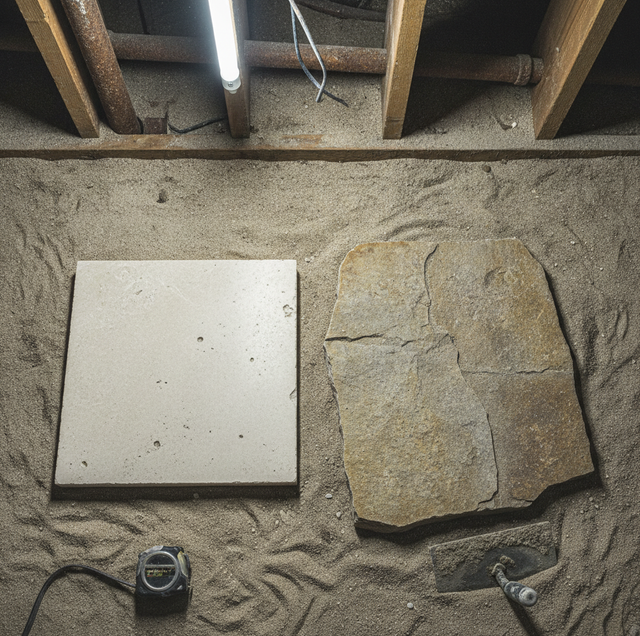
Travertine is a sedimentary limestone that forms around mineral springs, and the quarry cuts it into standard tiles and pavers. That is the single fact that drives most of its behavior on a patio. Because it arrives in set sizes with squared edges, it lies like flooring: consistent thickness, repeating pattern, tight joints. The exposed face is usually tumbled or honed, so it is fairly smooth to the touch but not polished and slick. Travertine tends to be light in color, in the cream, ivory, and tan family, and that light color is a big reason it stays cooler in direct sun.
Flagstone is a category, not one rock. It covers flat, layered stones such as sandstone and quartzite that split naturally along their bedding planes into broad, thin slabs. Nobody sizes flagstone to a tile dimension. You get random shapes, random outlines, and a cleft face, meaning the top surface is the natural break line of the stone, with its own texture and slight relief. Color depends entirely on which stone you buy, from buff and gold sandstone to gray, rust, and mixed-tone quartzite.
The short version: travertine is a manufactured-to-size product made from a natural material, while flagstone is the natural material handed to you close to how it came out of the ground.
Look: Uniform Order vs Rustic Randomness
This is usually the first thing people react to, and it is the cleanest way to separate the two.
Travertine reads formal and even. Because every piece shares a size or a small set of coordinated sizes, it lays into geometric patterns: a running bond, a grid, or the classic French pattern that mixes four tile sizes into a repeating block. Joints are narrow and consistent. The eye reads it as intentional and tidy, which suits contemporary homes, symmetrical pool surrounds, and anyone who wants the patio to feel like an outdoor room rather than a piece of the yard.
Flagstone reads organic. Irregular slabs fit together like a hand-cut puzzle, with joints that widen and narrow as the shapes demand. No two installations look the same, and the surface carries natural color variation within a single piece. It suits ranch-style and rustic homes, garden paths, and patios that are meant to blend into planting beds and boulders rather than stand apart from them. If you want the stone to look placed rather than installed, flagstone gets you there.
Neither look is better. They are aimed at different houses.
Heat Underfoot: A Real Difference, With a Caveat
In a place with strong sun, how the surface feels on bare feet is not a small detail, especially around a pool where people walk barefoot all day. Here, travertine has a genuine edge, and it comes from physics rather than marketing. Its light color reflects a good share of sunlight rather than absorbing it, and dense limestone does not retain heat the way a dark, heat-absorbing stone does. The result is a deck that stays noticeably cooler underfoot than a dark stone sitting in the same sun, which is exactly why travertine is such a common pick for pool surrounds.
Flagstone is where you have to pay attention, because flagstone is a category. A pale buff sandstone can stay reasonably comfortable, while a dark charcoal or deep rust slab will drink up sun and get hot enough to send bare feet hopping. The material itself is not the deciding factor here; the color you choose is.
Two things keep this honest. First, strong sun is the only stressor a patio faces. The same stone also withstands big day-to-night temperature swings, hard-water splashes, and years of foot traffic, so heat is one factor among several rather than the sole decision-maker. Second, no stone is cool in peak afternoon sun; travertine is cooler than a dark alternative, not cold. In shade or in the cooler months, the gap between the two narrows to almost nothing.
Slip and Traction: Texture Is King
Wet stone and bare feet are a bad combination if the surface is smooth, so traction matters most right where water lands, around pools, fountains, and any patio that sees sprinklers or rain.
Flagstone wins on raw texture. Its cleft face, the natural split surface, has fine ridges and relief that give feet something to grip even when the stone is soaking wet. That built-in grip is one of the strongest arguments for flagstone on a pool deck or a stepped path.
Travertine holds its own as long as you choose the right finish. Tumbled travertine has softened edges and a slightly textured, matte surface that grips well underfoot when wet. The finish to avoid near water is a smooth, honed, or polished stone of any kind, because a glassy surface turns slick the moment it is wet. If slip resistance is the priority, the rule is simple: pick texture over shine, and both stones can serve.
Installation: Planned Pattern vs Custom Fit
Here, the uniform-versus-irregular split shows up as labor.
Travertine installs faster because the sizes are known before anyone starts. An installer can lay out the pattern, snap lines, and set piece after piece into a planned grid with even joints, much like tile work scaled up for outdoors. Fewer cuts, predictable results, less guesswork.
Flagstone is hand-fitted. Someone has to sort through the pieces, choose which slab goes where, and trim edges so the irregular shapes nest together with acceptable joints. It is closer to solving a puzzle than following a plan, and doing it well takes an experienced hand. The payoff is the one-of-a-kind look, but the labor is higher and the timeline longer.
Both share a non-negotiable: a proper base. Natural stone is heavy, and it only performs long-term over a correctly prepared and compacted sub-base with the right bedding underneath. Skip the base prep, and even the best stone will settle, rock, and open up its joints. Because the material is heavy and the base work is what makes or breaks the result, this is a job for a professional crew rather than a weekend lift.
How They Are Sold and Estimated
The buying process differs in a way that catches people off guard, so it is worth knowing before you plan a budget or a delivery.
Travertine is sold in standard tile and paver sizes. You can count coverage cleanly by the square foot because every piece is a known dimension, which makes ordering and pattern planning simple.
Flagstone is often sold by the ton in random pieces. You are buying weight, not a tidy count of squares, and the irregular shapes mean some material is lost to cutting and fitting. A good estimate for flagstone builds in that waste, so you order enough to cover the area after trimming rather than the bare square footage on paper. It helps to work from the same supplier throughout, since color and thickness can vary between stone lots.
Quick Comparison
| Factor | Travertine | Flagstone |
|---|---|---|
| Shape and size | Uniform cut tiles and pavers, set sizes | Irregular natural slabs, random shapes |
| Look | Formal, even, repeating patterns | Rustic, organic, one-of-a-kind |
| Heat underfoot | Cooler; light color reflects sun | Varies with color; dark slabs get hot |
| Surface and grip | Tumbled grips well; avoid polished | Cleft face grips strongly when wet |
| Install | Faster, planned pattern, tight joints | Hand-fitted puzzle, wider joints |
| Sold by | Square feet, standard sizes | Often by the ton, random pieces |
Which One Fits Your Patio
If you want a clean, coordinated pool deck that stays cooler on bare feet and goes down predictably, travertine is the natural fit, provided you choose a tumbled finish for grip and plan on sealing it. If you want a rugged, natural look with excellent wet traction, and you like that every square foot is unique, flagstone earns its keep, as long as you accept the custom fitting and the by-the-ton buying. Both are real natural stone; both require a proper base and periodic resealing; and both reward buying from one source, so color and thickness stay consistent across the job.
Frequently Asked Questions
Which one stays cooler to walk on in the sun?
Travertine, and the finish matters as much as the color. Filled travertine, where the natural surface holes are filled at the factory, behaves differently underfoot than unfilled travertine, affecting both heat and slip, and a light ivory or beige tile reflects more sunlight than a dark stone. Flagstone's temperature swings with the color you pick, so a pale slab stays comfortable while a dark one gets hot enough to hop across.
What's the real difference in how they look?
Travertine comes in uniform-cut tiles, including a French pattern that mixes four tile sizes into a repeating block for an old-world look, so it reads as deliberate and even. Flagstone is laid randomly in the crazy-paving style, where irregular slabs of different shapes nest together without repetition. One looks like a designed outdoor floor; the other looks like natural stone set into the ground.
Which is easier and faster to install?
Travertine. Its consistent sizes drop into a planned pattern with tight joints, typically about 1/8 to 1/4 inch wide, so a crew can lay it quickly. Flagstone is hand-fitted with wider, irregular joints that are often filled with polymeric sand or packed with mortar, which takes more labor and skill and stretches the timeline.
Do both need to be sealed?
Yes. Both are natural stone with some porosity, so they are sealed to resist staining and, especially for travertine, to protect the surface from acids and pool chemicals. The sealer wears over time and is refreshed periodically to keep that protection working.
How are they sold and priced differently?
Travertine is sold in standard tile and paver sizes you count by the square foot, so coverage is easy to estimate. Flagstone is often sold by the ton, and its thickness is chosen by use, a thinner patio flag set over a prepared base versus a thicker stepper set straight on grade, which changes the tonnage you need for the same area and the waste lost to trimming.
Which grips better so it isn't slippery wet?
Flagstone's naturally cleft, textured surface gives strong traction when wet. With travertine, the finish decides it: a honed or polished travertine turns slick the moment it is wet, so a tumbled or brushed finish is the one specified around pools where bare wet feet are constant.
Planning a paver patio or replacing failing ones? — Get quality pavers and the right base materials for a patio that stays level. North Valley Stone Supply LLC serves Phoenix, Scottsdale, Tempe. Call (623) 244-8657.