
Why Is My Pool Tile Crusted With White Calcium Buildup?
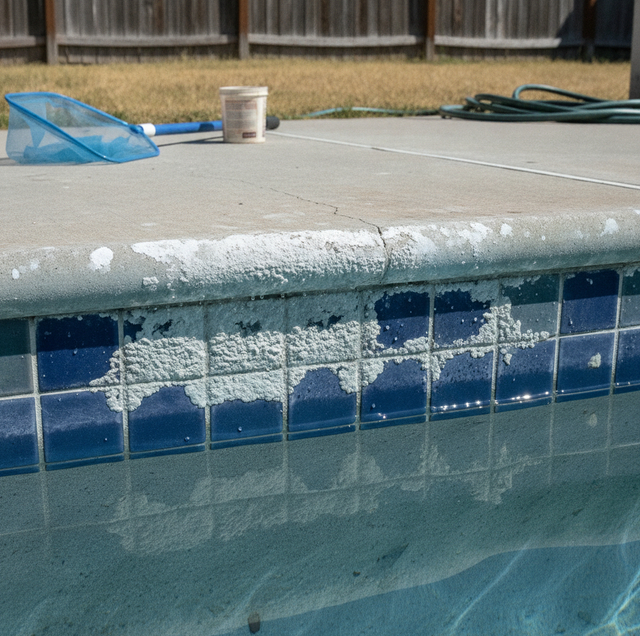
That chalky white band riding along your waterline tile is calcium that has left the water and hardened onto the surface. It starts as a faint, cloudy film, then thickens into a crust that ordinary brushing will not touch. It is one of the most common cosmetic problems a pool develops where the water is hard, and evaporation runs fast, and it is treatable once you know which of the two kinds you are dealing with. Before you reach for a stronger scrubber, the first job is to identify the deposit, because carbonate and silicate come off in completely different ways.
Where the White Crust Comes From
Pool water always carries dissolved calcium, and it holds that calcium in solution only within a narrow chemistry window. When the water tips out of balance, the mineral drops out and cements itself to whatever surface it meets first. Three drivers push it out of solution: high pH, high total alkalinity, and high calcium hardness. Pool professionals often track this tendency with the Langelier Saturation Index, a calculation that combines pH, temperature, alkalinity, calcium hardness, and dissolved solids into a single number. A positive index means the water is oversaturated and will shed calcium onto tile and plaster; a negative one means it is corrosive instead.
Evaporation concentrates the problem exactly at the waterline. As surface water leaves as vapor, the calcium it held behind stays put and builds up in a tight band. That is why the crust forms in a ribbon at the water's edge rather than spreading evenly across submerged tile.
The Two Types, and Why It Matters
Telling the two deposits apart is the single decision that controls how you remove them, and there is a simple bench test for it.
Calcium carbonate is the common, more forgiving form. It looks white, chalky, and powdery, and it is relatively soft. The tell is that it reacts to acid: put a drop of white vinegar or a diluted acid on it, and it fizzes and foams as the acid releases carbon dioxide. Because it is soft, you can usually lift it with a pumice stone on suitable tile, a diluted acid solution, or a commercial calcium scale remover and some patience.
Calcium silicate is the stubborn form. It shows up grayish-white, forms a harder and denser layer, and takes far longer to accumulate. Crucially, it does not fizz with acid the way carbonate does. Because it is so dense, acid and hand scrubbing barely dent it, and clearing it usually calls for a professional abrasive method such as bead or media blasting. If your deposit shrugs off vinegar and refuses to soften, treat it as silicate.
| Symptom you see | Likely deposit | How it comes off |
|---|---|---|
| White, chalky, powdery; fizzes with vinegar | Calcium carbonate | Pumice on hard tile, diluted acid, scale remover |
| Grayish-white, hard, dense; no fizz | Calcium silicate | Professional bead or media blasting |
| Crust returns fast after cleaning | Chemistry still off | Correct pH, alkalinity, and calcium hardness first |
Removing It Without Damaging the Tile
Match the method to both the deposit and the surface, because the wrong tool trades one problem for a worse one. For soft carbonate, a pumice stone works on hard ceramic or natural stone but will scratch glass and glazed finishes, so keep it off anything delicate. A diluted acid solution or a formulated scale remover dissolves carbonate with far less scrubbing and less risk to the surface. Some pool owners use a heavily diluted muriatic acid mix, but acid is hazardous, etches plaster and grout if it dwells, and demands eye protection and ventilation, so a milder commercial product is the safer first choice.
Hard silicate and any buildup on glass tile or a delicate finish is where abrasive blasting earns its place. The media matters: soft options such as crushed glass bead, sodium bicarbonate (soda), or magnesium sulfate (salt) media strip the deposit while being gentler on the glaze than hard silica sand, which can etch tile and is a respiratory hazard. This is precise, dusty work best left to a technician with the right compressor and media, which is why a widespread or rock-hard crust is usually a call for a pro rather than an afternoon with harsher and harsher scrubbers. The goal is clean tile, not scratched tile.
Why Hard Water and Fast Evaporation Drive This Buildup
In a hot, dry climate with hard tap water, calcium buildup on pool tile is closer to a certainty than an occasional nuisance, and two local forces explain why. The water arrives already carrying a heavy mineral load, so there is ample calcium ready to deposit the moment chemistry drifts. Then the intense heat and low humidity drive rapid evaporation, concentrating those minerals right at the waterline and thickening the band quickly. Wide day-to-night temperature swings add mechanical stress to tile and grout on top of the scaling. Keeping the water balanced, brushing the tile on a regular schedule, and clearing deposits while they are still soft carbonate are what hold the waterline clean in conditions that keep working against it.
Frequently Asked Questions
Does calcium buildup mean my pool chemistry needs correcting right now?
Often yes, but not always. Fresh scale forming within weeks of a cleaning points to water that is currently oversaturated, so a full test of pH, alkalinity, and calcium hardness is the next step. An old crust on a pool you just bought may date from a past owner's habits, and the water may already be balanced today. A pool professional confirms this by tracking whether the band grows back between service visits and by calculating the saturation index from a fresh water sample rather than judging by the tile alone.
How do I keep the scale from returning after I clean it?
Hold pH toward the lower end of the acceptable range, keep alkalinity from drifting high, and bring calcium hardness down if it sits above the recommended band. Topping off with softened or filtered fill water instead of raw hard tap water slows how fast minerals reconcentrate at the waterline. A weekly brushing of the tile before deposits harden, plus keeping the water level steady so the band does not creep, keeps the carbonate soft enough to wipe rather than letting it cement into a crust.
Is the scale on my salt cell handled the same way as the scale on the tile?
No, the location changes the method. A salt chlorine generator's cell has thin metal plates coated with a catalyst, so you never take a pumice stone or blast it. Instead, you remove the cell and soak it in the manufacturer's recommended acid-and-water solution until the flakes release, then rinse. Some newer cells self-clean by reversing polarity on a timer, which reduces but does not eliminate scaling, so a periodic inspection still matters even on those units.
Will the buildup hurt the tile or grout if I just leave it?
The deposit itself sits on top and rarely damages a hard glazed tile, but leaving it invites two problems. Thick scale traps grime and can hide grout that is quietly eroding underneath, and repeated harsh scraping by a frustrated owner does more harm than the calcium would. On natural-stone waterlines, mineral crusting can wick into the stone's pores over time, so clearing it while it is thin protects the surface better than waiting for a rock-hard layer.
Can sealing the tile or stone slow the buildup down?
A penetrating sealer on natural stone or unglazed tile fills the pores so that minerals grip less and future cleaning goes faster, though it does not prevent scale from forming when the water remains oversaturated. Glazed ceramic and glass are already nonporous, so the sealer adds little there. Any sealer has to be rated for constant submersion and applied to a fully dry, scale-free surface, which is why resealing usually follows a cleaning rather than replacing it.
When does the entire waterline need blasting rather than spot cleaning?
A pro reserves full-waterline blasting for a continuous hard crust ringing the pool, silicate that will not soften, or decorative glass tile that pumice would scratch. A single stubborn patch on otherwise sound carbonate is a spot job, treatable with a scale remover and a little patience. The tell is uniformity: if the band is even, dense, and unresponsive to a milder approach all the way around, blasting the whole line at once gives a consistent result rather than a patchwork of cleaned and dull sections.
Reading the Deposit Before You Reach for a Tool
The white crust on your waterline is calcium, left behind by unbalanced water and concentrated where evaporation is fastest; clean removal comes down to one early call: soft carbonate that fizzes with vinegar, or hard silicate that does not. Carbonate yields to pumice, diluted acid, or a scale remover on the right tile; silicate and glass tile belong to gentle blasting media rather than brute scrubbing. Because balanced water is what keeps the deposit from returning, correcting pH, alkalinity, and calcium hardness is as much a part of the fix as the cleaning itself, especially where hard water and fast evaporation make scaling a constant.
If calcium has crusted your waterline tile past a simple scrub, we can restore the tile and stone the right way for our climate. North Valley Stone Supply LLC serves Phoenix, Scottsdale, Tempe, and the Valley. Call (623) 244-8657.