
Travertine vs. Porcelain Pavers: Which Survives Arizona Heat?
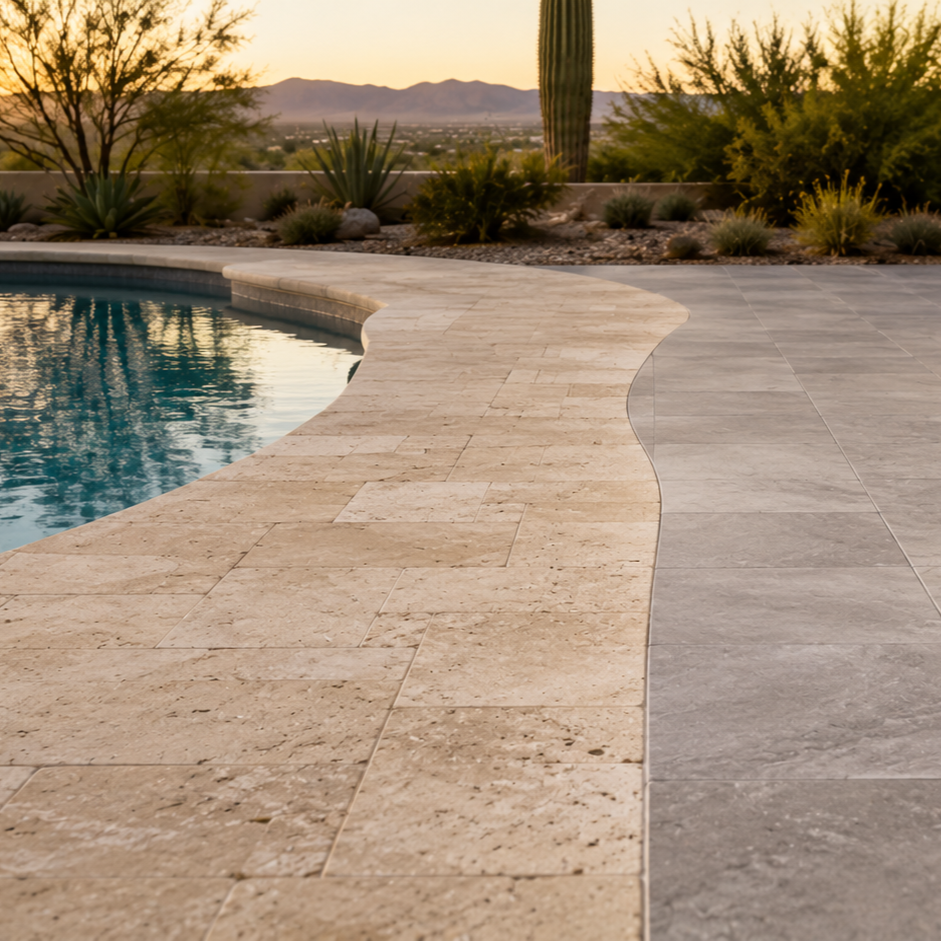
When you are choosing pavers for an Arizona patio or pool deck, the two names that come up most are travertine and porcelain — and both are truly good choices for the desert. The catch is that they're good at different things. One is natural stone prized for staying cool, the other is engineered for toughness and low upkeep. Knowing how each behaves under relentless sun, around water, and over years of heat is what helps you pick the one you won't second-guess.
What Each One Actually Is
Travertine is a natural stone, formed over time and quarried into pavers. Because it's natural, every piece has its own subtle variation in color and texture, which gives a patio that warm, organic look. Being natural stone also means it's porous — it has tiny openings that can absorb water and spills.
Porcelain pavers are manufactured. They're made from refined clays fired at very high temperatures, which produces an extremely dense, hard tile that's nearly non-porous. That manufacturing also lets porcelain mimic the look of stone, wood, or concrete with consistent color from piece to piece. Density is the source of porcelain's greatest strengths.
Heat Underfoot: The Desert Dealbreaker
In Arizona, how hot a paver gets matters as much as how it looks, especially around a pool where people walk barefoot. This is travertine's standout advantage: natural travertine tends to stay noticeably cooler underfoot than many other surfaces, because the stone doesn't absorb and hold heat the same way denser, darker materials do. Its typically light, earthy colors help too, since lighter surfaces reflect more sun.
Porcelain's heat depends heavily on color. Light-colored porcelain stays reasonably comfortable, but dark porcelain absorbs more sun and can get hot to the touch on a brutal afternoon. So if a cool pool deck is the priority, travertine — or a light-colored porcelain — is the smarter pick.
Durability, Staining, and Upkeep
This is where porcelain pulls ahead. Because it's so dense and nearly non-porous, porcelain resists stains, doesn't absorb spills, and shrugs off the sun's UV without fading. It generally doesn't need sealing, and it's very hard to scratch or chip in normal use. For a low-maintenance surface that looks the same in ten years, porcelain is hard to beat.
Travertine is durable too, but its porosity means it needs care. It should be sealed to resist stains from spills, oils, and pool chemicals, and that sealing needs refreshing over time. Left unsealed, it can stain and is more prone to etching from acidic spills. Travertine can also develop the small surface pits that are natural to the stone. None of this makes it a bad choice — it's just a surface that asks for a bit of maintenance in exchange for its looks and coolness.
| Factor | Travertine | Porcelain |
|---|---|---|
| Type | Natural stone | Manufactured tile |
| Heat underfoot | Stays cooler | Cooler if light; hot if dark |
| Porosity | Porous; needs sealing | Nearly non-porous |
| Stain resistance | Good if sealed | Excellent |
| Fading in sun | Holds up; natural tones | Excellent UV resistance |
| Maintenance | Periodic sealing | Very low |
| Look | Natural variation | Consistent; many styles |
Which Fits Your Project
It comes down to what you value most. If you want a pool deck that's kind to bare feet, a warm, natural look, and you don't mind sealing it now and then, travertine is the classic desert choice and the comfort winner. If you want the lowest-maintenance, most stain- and fade-proof surface and a consistent modern look, porcelain is the tougher, more carefree option — just lean toward lighter colors so it stays comfortable in the sun. Both handle Arizona's heat and UV well for years; the "better" one is simply the one matched to how you'll use the space and how much upkeep you want to do.
A practical tip, either way: color and finish matter as much as the material. Lighter tones stay cooler, and a textured (non-slip) finish is worth choosing around any pool or wet area.
It also helps to think past day one. Travertine develops a lived-in, weathered character over the years that many homeowners love, but that patina comes with the upkeep of resealing and the occasional filled pit. Porcelain looks essentially the same in year ten as it did on install day, which is exactly the appeal for people who want to set it and forget it. Neither path is wrong — it's a question of whether you enjoy a natural material that ages, or prefer a manufactured one that stays put. Picturing how you want the space to look and how much you want to maintain it a decade from now is often what makes the choice obvious.
Frequently Asked Questions
Does travertine really stay cooler than porcelain in the sun?
Generally, yes. Natural travertine tends to stay cooler underfoot than denser materials, and its typically light, earthy colors reflect more sunlight. Porcelain's temperature depends on its color — light porcelain stays fairly comfortable, but dark porcelain absorbs more heat and can get hot. For a barefoot pool deck in Arizona, travertine or a light-colored porcelain is the cooler choice.
Do travertine pavers need to be sealed?
Yes. Travertine is a natural stone and porous, so sealing helps it resist stains from spills, oils, and pool chemicals, and reduces etching from acidic liquids. The sealer needs to be refreshed periodically. Porcelain, by contrast, is nearly non-porous and generally doesn't require sealing, which is one of its main maintenance advantages over travertine.
Will porcelain pavers fade in the Arizona sun?
Porcelain is highly UV-resistant and holds its color very well, even under intense desert sun, because the color is fired into the dense tile. That fade resistance is one of porcelain's biggest strengths. Travertine also holds up well, since its color comes from the natural stone, so it does not typically fade the way some lower-quality surfaces do.
Which is more durable, travertine or porcelain?
Both are durable, but in different ways. Porcelain is extremely dense, hard, stain-resistant, and low-maintenance, making it the more carefree choice. Travertine is a solid, long-lasting natural stone, but it is porous, so it needs sealing and is more prone to staining or etching if neglected. For the lowest upkeep, porcelain leads; for natural looks and cool comfort, travertine is worth the maintenance.
Are travertine or porcelain pavers better around a pool?
Both work well around pools. Travertine is popular there because it stays cooler underfoot and isn't slippery in textured finishes, though it should be sealed against pool chemicals. Porcelain is excellent for stain resistance and low maintenance — just choose a light color and a textured, slip-resistant finish so it stays comfortable and safe around water.
Match the Paver to How You'll Live On It
Travertine and porcelain aren't really competing for the same crown — they're built for different priorities. Travertine is the cool-underfoot, naturally beautiful stone that rewards a little sealing. Porcelain is the dense, fade-proof, low-maintenance tile that asks for almost nothing but performs best in lighter colors. Decide whether barefoot comfort or carefree durability matters more, choose a light tone and a textured finish for any wet area, and either one will serve an Arizona patio beautifully for years.
Choosing pavers for your patio or pool deck? — Compare travertine and porcelain in person and find the right fit for your space. North Valley Stone Supply LLC serves Phoenix, Scottsdale, Tempe. Call (623) 244-8657.