
Is 3 Inches of Fire Glass Too Deep Over the Burner?
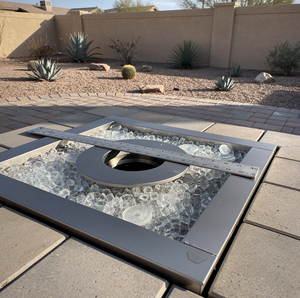
The question arrives at the counter in one sentence: How much fire glass, and how far up the pan should it go? It sounds like a single measurement. It is two. One depth convention is measured from a named point, the top of the burner. A second comes with no such point, and the two readings differ by a burner's height. Neither convention is wrong about the glass itself, but a buyer who takes that second range as a cover figure measured over the burner buries the ports on a gas appliance. The glass has not changed. The place you started measuring from is the whole of the difference.
Two Published Depths, and Only One Comes With a Starting Point
One depth convention specifies a depth of 1 to 1.5 inches of fire glass over the burner, without overfilling the fireplace or fire pit. Measure from the bottom of the pit to the top of the burner, then add 1 to 1.5 inches for the glass depth. The figure is not the bed depth. It is the depth of the slice above the burner.
Another convention gives a different number without a basis attached, placing the layer at 2 to 4 inches deep and leaving the starting point unmarked. One way of arranging media has the glass spread over the burner, while a worked example enters the burner pan's 2-inch depth. The ambiguity is in which convention is being used, not in the glass.
How Much Fire Glass Sits Over the Burner in a Bowl or a Trough?
Feature type moves the total, with feature-specific ranges instead of a single figure. A round fire pit uses 2.5 to 3 inches of glass, a fire bowl uses 2 to 2.5 inches, a rectangular or four-sided pit uses 3 to 4 inches, and a ventless or linear fireplace uses 3 to 4 inches or more. A reason sits beside each one: shallow bowls require less depth to create a lively flame without choking airflow, and longer burners require deeper coverage to hold the flame even end-to-end across a long trough.
Not one of those figures carries a starting point, and the basis changes what they mean. A fire bowl filled to 2 inches over a burner ring, standing an inch and a half proud of the floor, leaves half an inch above the ports, under the 1 to 1.5-inch window recommended above. Fuel type splits the recommendation again: 2 to 3 inches over natural gas burners and no more than 1 inch over propane.
Two features of the same width can have different glass weights, and a depth copied from a neighbor's pit does not carry over to yours. The inside dimensions of your pan, the height of the burner off the pan floor, and the target depth are three separate inputs, and a calculator wants all three before it returns a weight. Two of them belong to hardware you own.
The Media Is Ordered by Weight Because the Pieces Are Not Uniform
Fire glass is sold by weight because, unlike water or mulch, the pieces are not uniform in size or shape, so volume alone, like cubic feet, can be misleading. Pounds give a consistent, usable estimate, especially when ordering online. A cubic foot of one cut and a cubic foot of another do not weigh the same, so a depth in inches must be converted to pounds before an order can be written.
That conversion is the job of a calculator, which makes a bag count an arithmetic output. Suppliers stock fire glass in bag sizes from 2.5 pounds up through 40 pounds, with some working their tables in 10-pound bags. A bag size doesn't fix depth, because depth depends on the area being covered. Bring pan dimensions to a counter, and the weight follows.
The Burner Manufacturer's Own Number Overrides Any Online Calculator
A calculator is a geometry problem with a density constant in it. It takes the pan's inside dimensions and a target depth, multiplies them, and returns a weight. It never sees the burner itself: where the ports sit along the ring or the pan, how tall the burner stands off the floor, how gas is distributed across a long trough, and what the appliance's own instructions allow over those ports. Two features with identical inside dimensions but different burners require different amounts of glass, and no page of arithmetic can derive that difference from the outside. The paperwork that shipped with the burner was written for that burner and for no other one at all.
Where the two figures disagree, the burner's own number is the one to order against. A calculator gives an estimate. The appliance instructions give a specification, and the gap between them is not always small.
Before an order is written, three things are worth having in hand: the make and model of your burner, the inside dimensions of your pan, and the height of the burner off the pan floor. If that paperwork has gone missing, the burner manufacturer will state a media depth for the model. Anything at the burner, at the ports, or at the gas connection belongs with a licensed gas professional, and you are only filling the pan.
Overfilling Shows Up at the Flame Before It Shows in the Glass
The failure mode of a deep bed is airflow. The instruction for arranging media is to spread it evenly over the burner and stop inside the stated range, because excess glass can block airflow and affect flame quality. A flame that looks weak or muffled means glass needs to come off for proper gas flow. The same limit applies to the ports themselves: avoid completely burying the burner ports, and keep glass at the recommended depth so the flame can breathe properly.
A weak or muffled flame after a fill is a depth question first, so take glass off rather than turning the gas up, and leave the burner, the ports and the gas connection to a licensed gas professional. Sooting that returns once your depth is right is usually a gas mixture problem instead of a media fault.
Setting the Bed: Level Glass, Dry Glass and a Cold Burner
Depth only means anything across a level bed. Glass heaped toward the middle of a round pan and thin at the rim puts more media over the center ports than over the outer ones, and the flame pattern follows the high spot. Filling in two or three passes and leveling with a plastic scoop between them keeps the surface flat and the port tops at the same distance under the glass around the burner.
Adding or leveling glass over a lit or hot burner burns hands, so shut the gas off at the valve and let it go cold first.
One thing worth knowing before a washed bed goes back in: glass returned damp holds water in the pack, and the first burn drives that water off as steam through the media. A finished bed sits flat across your pan, fully dry, with the port tops just under the surface and no glass banked against the pan wall, doing nothing more than covering the burner and throwing the flame back at you.
Frequently Asked Questions
How much fire glass covers a burner in a square pan?
Working the numbers: a 36 by 36 inch square pit filled to 3 inches takes 70 pounds, roughly seven 10 pound bags, while a 48 by 12 inch rectangle at that depth takes 30. Area drives your order more than outline.
Does reflective fire glass weigh more per bag than crushed?
This gets stated two different ways depending on the source. One convention has chunky glass that weighs more per scoop than reflective glass, while another has reflective glass that is denser than crushed glass. Order the pounds you calculated for your pan and let your scoop count follow.
Can old fire glass be reused after a pan is emptied?
Yes. Fire glass, unlike wood ash, does not need to be replaced after every use, and a batch lasts many seasons. A wash in equal parts water and household vinegar, rinsed through a mesh strainer, restores it. Top up your bed with the cut you own so your surface stays even.
Is a deeper bed of fire glass better for heat?
Deeper is not always better. A deeper fill is credited with better flame performance and longer burner life for larger pits or higher BTU burners, at 3 to 4 inches, while fine or reflective glass in your pan calls for closer to 2 inches.
What size fire glass suits a long linear burner?
Cut and width are the choices, since depth stays where your feature puts it. Sizing runs 1/4 to 3/4 inch wide, with size depending on the style you pick for your pan. Cuts are sold as crushed glass, fire beads, fire nuggets, and ice cubes.
Should a calculator figure or the manufacturer figure win?
A real-world example shows why the manufacturer figure can override the calculator. Working a fire pit model at a 24-inch burner pan and roughly 2 inches of depth, the calculator suggests a total of 48 pounds. After speaking with the manufacturer, approximately 31 pounds of fire glass operate best on that model. About a third less than the arithmetic is the gap your burner maker can close for you when you call.
Buyers who bring the pan's inside dimensions, the burner height, and model number to the counter leave with the right weight and cut of fire glass — special orders usually arrive within 72 hours depending on availability. North Valley Stone Supply LLC serves Phoenix, Scottsdale, and Tempe. Call (623) 244-8657.