
Best Stone for a Barbecue Island: Heat, Grease, and Sun
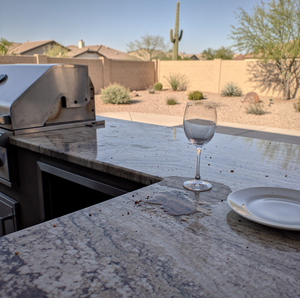
A barbecue island asks things of a stone that a patio never asks. Heat arrives concentrated at one opening rather than spread thin across the whole floor, so a narrow band of material runs hot while the stone a foot away sits at ambient temperature. Grease, wine, marinade, and citrus land on the same few square feet week after week, in a spot that gets wiped rather than hosed. And people set food down on it and rest a forearm on it while they talk, which turns surface temperature and cleanability into material questions instead of comfort ones. Those demands, not a ranked list of stones, are what should drive the choice.
Quick Answer: Dense, low-porosity materials handle a barbecue island best: granite, quartzite, and porcelain slab. Sealing slows staining on more open stone but does not make it heatproof, and engineered quartz does not belong on an outdoor island.
Heat at the Grill Cutout and What Thermal Shock Does
A built-in grill loads heat into the stone around its opening two ways: radiant heat off the hood and firebox, and conducted heat through whatever the appliance body touches. What does damage is the difference across the island rather than its average temperature. One band of stone expands while the material just beside it stays where it was, and the stress collects along the boundary between them. Repeat that a few hundred cookouts and any pre-existing weakness in the slab has somewhere to go.
Materials take that unevenly, and the reason sits in how they formed. Granite and quartzite are dense, crystalline, and were themselves formed under heat and pressure, so ordinary grill temperatures move them very little. Porcelain slab is fired far above anything a backyard grill produces. Carbonate stones such as travertine, limestone, and marble handle heat better than most homeowners expect, but they carry more internal variability: bedding planes, filled voids, and heavy veining are lines where stress gathers rather than spreads, and those open first.
Engineered quartz is the one material to rule out on an outdoor island. Its strength comes from a resin binder that holds ground quartz together, and the resin is the part that gives way to the outside: sustained heat softens and discolors it, and ultraviolet exposure yellows and breaks it down.
Thermal shock is the quick version of the same problem. Rain hitting a slab that has been baking all afternoon, or a bucket of ice going onto a hot bar top. Dense, uniform material absorbs that without complaint. Material with internal flaws sometimes does not.
The grill's own listed clearances govern the size of the opening and what may sit against it. Those specifications come from the appliance manufacturer, and the installer building the island, and swapping in a different grill later can change them.
Grease, Wine, and Citrus: Two Different Ways a Top Gets Marked
Porosity means more than how much empty space a stone contains. What matters is whether that space connects, because connected pores act like a wick and isolated ones do not. Two stones can look equally solid and take the same spill in completely different ways.
Water-based spills mostly sit and evaporate. Oil is the hard case, because it never evaporates. It moves into connected pore space and stays there as a darkened shadow surface cleaning cannot reach. A wooden cutting board that has absorbed cooking oil for years never returns to its original color because the oil is inside the board rather than on it. Open stone does the same with bacon fat, olive oil, and marinade, and a barbecue island is the one outdoor surface where those land constantly.
That is where the material split shows. Travertine and limestone have the most open structure among common choices and readily take up oil. Granite is dense but varies by color and quarry, and some slabs darken where oil sits. Quartzite is dense and tight. Porcelain is vitrified all the way through, effectively closed, which is why red wine, turmeric, and grease sit on top of it and wipe away.
Acid works by a separate mechanism. Citrus, vinegar, and wine dissolve calcium carbonate on contact, leaving a dull, slightly rough spot rather than a colored one. On travertine, limestone, and marble, the surface itself has changed, so there is nothing left to lift out.
Surface Temperature at the Bar Top in Full Sun
Anything dense enough to survive the cutout is also dense enough to store heat, and stored heat leaves slowly. A stone top that has taken full afternoon sun stays warm long after the sun is off it, which is exactly when people are standing around it.
Where that matters is where skin lands: the seating side, the strip beside the grill where a plate waits, the edge people grip. Color does the same work here as it does on paving: a light surface runs cooler in full sun than a dark one of the same material, and on an island, that difference is felt on the few feet people actually touch.
Finish changes what the surface does with light. A polished face throws back more of what hits it and can produce real glare at low sun angles, while a honed or textured face reads softer and grips better when condensation from cold drinks runs across it. Neither finish makes a dark slab behave like a light one.
The strongest lever is usually shade rather than stone: a top that spends the afternoon under a structure never reaches the temperature that an identical slab does in the open. The same holds at the base of the island, where bare feet meet the ground paving rather than the island itself.
The Veneer and the Countertop Are Two Separate Decisions
The sides of an island and the top fail in different ways, so treating them as one material choice usually shortchanges one of them.
The veneer takes splash, airborne grease, drips running down from the top edge, and frequent cleaning. It rarely takes direct heat, and it never takes a hot pan. It also sheds water rather than holding it, so absorption matters less on a vertical face than it does on texture. Deeply textured stacked stone holds cooking residue in its shadow lines and needs a brush, while a flatter-faced panel or a smaller-format veneer at the cooking end wipes down with a rag. Whatever face you pick has to be washable where the cooking happens.
The top takes everything the sides do not: direct heat, food acid, standing oil, and hands. Those two lists rarely point at the same product, and nothing says one island has to be built from one material.
What Sealing Buys You on a Cooking Surface
An impregnating sealer soaks into the pore structure, making it harder for liquid to be drawn in. What it buys is time: the minutes between a spill and a wipe. It is not a coating, not a heat shield, and not permanent.
On a cooking surface it wears out faster than it would on a patio. Degreasers, repeated scrubbing over the same spots, and the hot band beside the cutout all shorten its working life, and the strip of stone that needs protection most is the strip that loses it first. Sealing routines written for a paver field cover a whole outdoor floor on a schedule; on an island, the decision narrows to the working top and the stone around the appliance.
Topical, film-forming sealers are a poor fit on a cooking top: they soften under a hot pan, cloud when trapped moisture has nowhere to go, and scuff where dishes slide.
No sealer makes stone a food preparation surface. Cut on a board and set raw food on a plate no matter what the top is made of. That is the right practice on granite, on porcelain, and on everything else; a denser material changes how easily the top cleans, not what you cut on.
The Frame That Carries the Stone
Stone is the visible half of this decision. The frame underneath sets the terms, and it is worth settling the material before the frame is built.
Weight is the first term: a thick natural stone slab is a different load from a thin porcelain panel, and a light metal frame narrows what can sit on top of it. Movement is the second. Stone is rigid and does not forgive a frame that flexes or settles unevenly, and that shows up as hairline cracking at the inside corners of the cutout, already the most stressed part of the top. Flatness is the third: veneer panels need a true, flat backing, and any wave in the frame face lands in the joint lines where it cannot be hidden.
There is a dimensional piece too. Veneer has real thickness, and the frame has to be sized for it so the finished top lands where you want it relative to the sides. That is a conversation to have while the island is still on paper, and it starts with knowing the materials.
Choosing for the Way You Actually Cook
If you sear hard on a high-output burner most weekends, the cutout is the governing condition, and the top should be chosen for thermal stability first. Granite, quartzite, and porcelain slab all clear that bar, and the choice among them comes down to color, finish, and how much staining you are willing to manage.
If the island is mostly a bar and the grill runs a few times a month, the demands invert. Surface temperature, glare, and how easily a spilled drink comes off matter more day to day than heat performance at the cutout ever will. That is where a lighter color and a honed finish earn their keep.
If you want a look that only a more open stone can give you, the way to get there is through placement rather than compromise. Carbonate stone can hold the seating side or the veneer while a denser material takes the working top beside the grill, and the island still reads as one piece because color family and finish carry across.
And if you already know you will not keep up with maintenance, choose for that honestly. A material that asks for nothing will look better in three years than one that asks for a routine you will not follow.
Take a sample home before you commit. Leave it in full afternoon sun for a day, put a drop of olive oil and a squeeze of lemon on it, wait an hour, then wash it. The result beats any spec sheet.
Frequently Asked Questions
Does a honed or leathered finish stain more easily than a polished one?
Usually yes, at least visibly. Mechanical finishes leave more microtexture on the surface, and that texture holds fingerprints, oil films, and cleaning residue, whereas a polished face sheds them. Polished faces carry their own trade-off, since gloss on some stones dulls under strong sun and repeated cleaning.
What should I expect where the countertop meets an outdoor sink?
That is where protection breaks down first. Constant wetting, drying, and detergent exposure cycle the sealer harder than anywhere else on the top, and hard water leaves a mineral film along the drip line that builds into a visible ring on a matte surface.
Should the countertop project past the island body?
A small projection with a drip groove cut into the underside is worth asking about. Without one, water running off the top curls back underneath and tracks down the veneer face, showing up as a dirty vertical stripe below the edge and as moisture sitting in the top joint.
Can I use the same material on the island that I used on the patio?
Sometimes, but usually not the same product. Paving material and slab material are produced in different thicknesses and to varying calibration tolerances, and paver units often have tumbled or chamfered edges that look out of place on a work surface.
How do you get a grease mark out of stone once it has soaked in?
By drawing it back out rather than scrubbing it off. A poultice, a paste left over the mark and allowed to dry slowly, pulls oil up out of the pore structure by capillary action as the moisture leaves. Scrubbing a degreaser into open stone often does the opposite, driving oil deeper.
Is soapstone a realistic choice for a barbecue island?
It handles heat well and does not need sealing, which suits a cooking surface. The catch is that it is soft next to granite or quartzite, so it scratches and dents from ordinary use. It also darkens over years of use into a patina that does not come back off. Mineral oil darkens it immediately, but that is a temporary evening-out that fades and gets reapplied, so plan around the aged color rather than the sample color.
Pick the top and the sides at the same visit — see slab and veneer options side by side before the island frame is built. North Valley Stone Supply LLC serves Phoenix, Scottsdale, and Tempe. Call (623) 244-8657.