
Bullnose or Square Edge Pool Coping? Start With Your Hand
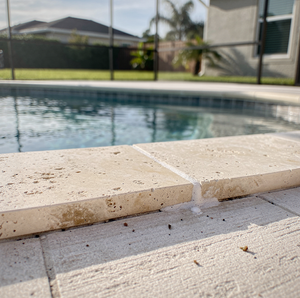
Watch someone climb out of a pool without using the steps. The forearms go flat, the hands curl over the edge, and a body's weight loads onto a few inches of stone. Then the same person sits down on that edge, heels in the water, and stays there. Coping is the only part of a pool people grip, and the part bare skin touches most. Its edge profile is a decision the hand makes first.
What Coping Does, and How Its Edge Gets Finished
Coping caps the bond beam, the thickened top course of the shell that the pool walls and the deck tie into. It covers the joint where the shell ends and the deck begins, and it takes the first hit of every splash and every wet body leaving the water. A slab laid flat would cover that joint. The profile exists because of what happens in the outer few inches: hands, feet, seated weight, dropped objects, running water.
Full and half bullnose
Bullnose means the edge is rounded over. A full bullnose turns the whole thickness into a half circle, so top and underside are one curve with no flat face left. A half bullnose rounds the top edge only and leaves the underside square, and that is what almost everyone means by bullnose coping. Full bullnose belongs on raised walls, spa dams, and step edges, touched from both sides.
Square edge
Square edge, also sold as straight edge or sharp edge, brings the face up to the top plane at a clean ninety degrees. Most fabricators break that corner with a tiny eased arris, a fraction of an inch of relief that keeps the line straight while taking the knife off it. Left unbroken, a true ninety-degree arris chips in handling. This is the contemporary profile.
Rolled and cantilever
A rolled edge, sometimes sold as a safety-grip edge, is a deeper curve with a slight undercut, so fingers hook under it rather than rest on top. Cantilever is not a stone profile at all: deck concrete is poured over a foam form strip on the bond beam, so the edge is formed in place.
Grip Is the First Thing the Edge Decides
A hand on a pool edge is not flat. The fingers curl over the corner, and the load runs through the finger pads and the middle joints, not the palm. A rounded profile keeps stone in contact along that curl, so weight spreads across four fingers. A square edge gives the same hand a narrow line of contact, and the load rides on the crease of the knuckles.
That shows up twice: pulling out of the water, and far more often, sitting on the edge with legs in while a thigh rests on the corner for an hour.
Wet hands also hold better where more skin touches stone, and a rolled edge gives fingers something to pull against. That is a claim about comfort and purchase, not an injury-prevention claim, and no profile substitutes for supervision or for proper handholds and steps.
The Square Arris Is What Chips
A corner has stone behind it in only two directions. On the flat top, a blow spreads into material on every side. At a ninety-degree arris, half that support is missing, so the stone fails locally and releases a flake instead of absorbing the load. A rounded profile keeps material behind every point of the curve, so the same impact leaves a scuff, not a divot.
What finds that corner is ordinary: the foot of an aluminum ladder, a chair dragged instead of lifted, a cooler set down hard, a telescoping pole.
Chips also show worse than they measure. The face of a piece has weathered, and the interior has not, so on a light limestone or a tumbled travertine a fresh break reads across the deck as a white notch. Fills exist, but on an edge that hands touch, a fill is felt as well as seen, so a chipped piece usually gets replaced, which means breaking a mortar bed.
A fresh chip leaves a fractured edge on the line hands grab, and feet push off. Tape a pad over it and keep traffic off that piece until it can be replaced: replacement means breaking the mortar bed, not a same-day repair.
Where the Water Goes When It Leaves the Edge
Water leaving a coping either separates and falls or wraps and runs back underneath. A moving film follows a surface it is already touching as long as that surface bends slowly, and it cannot follow a corner. That turn happens twice on a coping, and only the lower one decides where the water lands. A half bullnose rounds the top and leaves the underside square, so the film wraps the top curve, runs the face, and lets go at the bottom arris the way a square edge does. A full bullnose carries the curve all the way under, and a rolled edge undercuts it, so on those two the film can travel inward to the mortar bed and the joint above the waterline tile, which is meant to stay dry. Repeated wetting affects the setting bed and any sealant in that joint.
Those two are not stuck with it. A drip kerf, a shallow groove cut into the underside back from the edge, gives the film the abrupt turn the curve denied it, so the water lets go there instead of running inward.
If you choose a full bullnose, ask for a drip kerf where the curve turns under: a groove a quarter inch wide and a quarter inch deep, set back three-quarters of an inch from the front, cut before the pieces are set.
Heat Underfoot Belongs to the Material, Not the Profile
Under full sun, surface temperature is set by color, density, porosity, and finish. A pale, porous stone and a dark, dense one, a foot apart on the same deck, will not be close, and which stone stays coolest is a question about the stone.
What the profile changes is contact, not temperature. On a square profile, the sole sits flat on the top plane all the way to the corner. On a bullnose, the foot rolls over the curve, so less skin loads against the hot surface at that one spot. The effect is small, and anyone picking a profile to fix a hot-surface problem has chosen the wrong variable.
Overhang, and the Line Where Coping Meets the Waterline Tile
Coping projects past the face of the pool wall so runoff does not track down the tile, and that projection normally runs an inch to an inch and a half. The profile decides how much of it is left to work with. On a half bullnose, the curve consumes the upper part of the face, so the band below the edge is shorter and its shadow softer. A square edge shows the full thickness as a straight band above the tile, which is why the same overhang looks more pronounced. A full bullnose leaves almost no flat underside at all, which rules it out where something has to bear on that surface.
Under it all sits the joint between the top of the waterline tile and the underside of the coping. Deck and shell move differently, so that joint is detailed to move. A square profile leaves it a crisp shadow that any unevenness shows up in; a rounded profile blurs the line. Which tile goes below it is a separate decision.
The Material Sets How Sharp an Edge It Will Hold
Travertine is calcite, around 3 to 4 on the Mohs hardness scale, and it carries natural voids even when filled. A square arris in travertine is a line of soft unsupported stone crossing open pores. It chips on the truck, it chips during setting, and it keeps chipping. Its default profile is a bullnose for that reason, and where a square look is wanted, a filled and honed piece with a generous eased arris beats a sharp corner.
Limestone sits in the same hardness range but is denser and more uniform. It carries a square edge better than travertine and still gives it up under repeated impact, so a dense limestone with a visible eased arris is the compromise.
Granite ranks 6 to 7 on the same scale, is composed of interlocking quartz and feldspar, and holds a true 90-degree edge for decades. The trade is fabrication: a profile in granite takes far more diamond time than the same profile in travertine, so lead times run longer on anything non-stock.
Porcelain is fired rather than quarried and absorbs less than half a percent of its weight in water, which is what makes it the material square-edge designs are drawn around. Its caution is different: the edge arrives finished from the factory, a chip in a glazed piece exposes the body underneath in another color, and a piece cut on site needs its new edge ground and eased.
Cast concrete can be molded into any profile, making it the most flexible option on paper. Its limit is the arris again, since edge strength depends on the aggregate and the cure, and a molded square corner that breaks exposes the aggregate behind it.
Which material to buy is a comparison of its own; in this decision it is a limit on the profile rather than the subject.
Which Edge Fits Which Pool
For a household with young children and a lot of edge-sitting, or for a heavily used pool, a half bullnose or a rolled edge is the easier call: comfort under a forearm and a thigh, tolerance of what gets dropped, and marks that do not show. A rounded edge is still not a safety device.
For a contemporary pool where the drawn line is the design, a square edge is the whole intent, and softening it defeats the point. What matters there is the material beneath it: porcelain, granite, or dense limestone will still read as a straight line in ten years, and soft travertine will not. Color and finish still decide how that edge feels underfoot, so the heat question gets asked of the specific slab rather than of the category.
For a renovation, the existing bond beam and tile do most of the choosing. The old coping's thickness sets the elevation the deck meets and where the top of the tile lands. Thicker new pieces raise the deck joint; thinner ones expose tile never meant to show. Measure the existing overhang and the tile reveal first, then order a few spare pieces while the material is still available.
Frequently Asked Questions
Can I use bullnose on part of the pool and square edge on the rest?
Yes, usually by zone: rounded on the swim-out, the steps, and anywhere used for sitting, square along a raised beam or a spa wall read as a line. The constraint is thickness. Order both profiles from the same lot, because an eighth of an inch of difference in top thickness reads as a step where they meet, and the setting bed will not hide it.
What radius is a half bullnose on pool coping?
On the two-inch pieces most stone coping is supplied in, a half bullnose is commonly cut anywhere from a half inch to the full inch a bullnose implies, with the underside left square. A full bullnose on that piece has a one-inch radius because it consumes the entire thickness. Radius is a fabrication spec, so ask for the number rather than the name.
Does square edge coping work on a raised wall or spillway?
It works well, and on a spillway it is usually the better choice. Water leaving a square lip releases in a cleaner sheet, while a rounded lip lets part of the flow cling and run down the face, leaving a mineral track on the wall below.
Is bullnose coping more slippery than square edge?
Slip is set by finish, not by profile. A polished or fine-honed top is slick when wet no matter what the edge does, and a tumbled, brushed, or flamed surface gives the sole something to hold. Choose the hand profile and the foot texture; they are separate specifications in one order.
Can existing coping be reshaped instead of replaced?
A sharp arris can be eased in place: a fabricator with a wet polisher can put a small break on an installed square edge and polish it back to a finish. Turning that edge into a real bullnose is different because the curve comes out of the piece's thickness, and that shaping happens before it is set. Wet grinding sends slurry into the water, so it is scheduled around a long filter run.
Does the coping profile affect where a handrail can go?
Usually not. Rail and ladder anchors are normally set into the deck behind the coping rather than through it, which leaves the beam and the coping joint unbroken. Where an anchor lands in a coping piece, the escutcheon flange needs a flat area to bear on, and a full bullnose has no flat top at the edge to provide it.
Handle the profiles before you order — feel bullnose, rolled, and square edges in the same stone side by side and decide with your hand instead of a photo. North Valley Stone Supply LLC serves Phoenix, Scottsdale, and Tempe. Call (623) 244-8657.