
Why Stamped Concrete Looks Worse Than Pavers by Year Ten
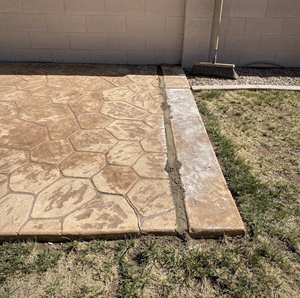
Stand at the edge of your own patio, and both surfaces are in front of you. The damage on each one travels a different distance. A crack runs across the stamped slab, starting somewhere near the house and continuing in a line that ignores the pattern pressed into it, straight through the imprinted stones, across the imprinted joints, out to the far side. On the paver field of the same age, nothing runs through anything. A unit or two sits low, and the low spot ends where those units end.
That difference comes down to whether the surface has joints, and the way each one ages follows from that. A stamped slab is a single piece of concrete with a picture of joints on top. A paver field is separate units with real ones between them.
One Surface Is Jointed Every Few Inches
A paver field is a set of separate units laid on a bedding layer with sand swept into the gaps between them. Those gaps are narrow. Joints between concrete paving units are 2 to 5 mm, which, on an 8-inch unit, gives you a working seam every 8 inches in both directions. Sand in that seam carries load sideways from one unit to the next, and it lets each unit shift a fraction of a millimeter without involving the unit two rows over.
A stamped slab has no seam of that kind. It is a continuous placement of concrete, and the pattern you see is pressed into the top with rubber mats while the surface is still plastic. The imprinted grout lines you are standing on are a groove in the top quarter-inch or so. Under them, the concrete is unbroken.
The slab does get relief cuts. A national standard for concrete floor and slab construction puts joint spacing on a plain slab at 24 to 36 times the slab thickness, so your 4-inch patio gets a cut every 8 to 12 feet. Between those cuts, whatever the slab does, it does as one piece. A working seam has to open and close repeatedly, which the sand joint and the saw cut both do, and which is why anything rigid bonded across one breaks its own bond.
What Happens to the Movement a Slab Cannot Release?
Take the movement in the order the slab meets it, from the day it is placed.
Concrete shrinks as it dries, and friction against what it sits on holds it down, so that shrinkage turns into tension inside the slab. A standard reference on concrete mix design puts concrete's tensile strength at roughly 8 to 12 percent of its compressive strength, so it pulls apart long before it is near crushing.
Then the daily temperature cycle takes over. The same reference gives concrete a coefficient of thermal expansion of about 5.5 millionths of its length per degree Fahrenheit. Run that across a 20-foot slab through a 60-degree swing, and you get about 0.08 inches of movement, which sounds like nothing until you ask where it goes.
On a paver field, it goes into the sand. A 3 mm joint on an 8-inch unit is about 1.5 percent of the run, compared with thermal movement of about 0.03 percent, so the joints allow roughly 40 times the room that movement needs.
On your slab there is nowhere for it to go but a crack. It starts at a stress raiser, an inside corner where the patio wraps a post, and runs until the tension lets go. What opens is the joint the slab never had.
Pavers move too. They settle, they lip, they rut, and you feel it underfoot. What sits under either surface is its own subject, the same subject for both.
The Color Sits in a Different Place on Each Surface
Integral pigment goes into the batch, so a stamped slab carries a base tone through its thickness. The color you actually look at comes from something else: a dry-shake color hardener, a blend of pigment, cement, and fine hard aggregate broadcast onto the fresh surface and floated in. That application rate is specified in pounds per hundred square feet, and a rate per square foot is what a surface layer has. It lives in the top fraction of an inch of the slab you walk on.
That layer takes your traffic. Grit under shoes works on the high points of the imprint first: the raised areas the float reached and the ones you walk on, while ultraviolet works on the pigment at the same time. When the hardener thins through, what is under it is base concrete at whatever gray the batch happened to be. Nothing brings the color back, because there is no color underneath to bring back.
A travertine or limestone paver has the opposite arrangement. The stone is the same material three-quarters of an inch down as it is at the surface, so wearing the top off exposes more of the same stone in the same color, with a slightly different texture. Porcelain pavers carry color through the body for the same reason.
Wet a section of the stamped pattern and watch the high points. If they darken to the color of the low spots, the sealer wore off. If they darken but stay gray instead of reaching it, the color layer is gone.
The Sealer Cycle and the Joint-Sand Cycle
The wet, saturated look your stamped patio has on the day it is finished comes from a film-forming sealer sitting on top of the concrete. Take the film away, and the same slab looks chalky and flat because the film darkens the surface and holds the depth in the imprint.
That film is a wear layer, and it wears where you walk. The path between the door and the pool loses its sheen first, so the patio goes patchy in sheen before it goes patchy in color, and the patchiness follows your traffic instead of the pattern. Renewing it is a whole-surface job because you cannot recoat a worn path without leaving a visible edge where the new film stops.
The paver equivalent is the joint. Sand works down and out under rain, irrigation and sweeping, and gets topped back up from the surface with a broom. A joint left low stops handing load sideways, so the sweeping is structural as much as cosmetic, and the sand goes back in from the top with no unit lifted and no edge to blend. Nothing has to be uniform across your patio for it to look right, because the units' appearance does not depend on the joint material. A travertine paver with a low joint still looks like a travertine paver. A stamped slab with a worn film looks like a different patio.
Repair Leaves a Line on One Surface and Nothing on the Other
A crack in your slab is permanent. Routing and filling it puts a different material with a different surface into the line, one that takes neither the imprint nor the color, so the repair shows as a line across your patio, and the crack goes on opening and closing under it.
An overlay is the other route: a polymer-modified cementitious topping laid over the entire slab and then stamped again. The old crack works its way up into it, which is reflective cracking. The new surface buys years.
A damaged paver is a different problem. The unit comes out with two flat pry bars and a new one drops into the same bedding. Nothing is cut, and nothing is patched.
A replacement does sit brighter than your field at first, because it has not weathered beside the others, and that difference narrows as it weathers in. The difference on a stamped patch does not narrow because the accent color it has to match was applied last. Release is a powder or a liquid laid between the stamping mat and the fresh concrete so the mat lifts away clean. The powders are pigmented and water-repellent, and once the slab is washed down, what remains in the low points of the imprint forms a second, darker accent color. That color is applied last and sits in the top eighth of an inch. Five years of shoes and sun take it off the high points and leave it in the grooves, and no fresh release on a patch reproduces the amount that has already gone from the surface around it.
Frequently Asked Questions
Do pavers ever crack the way a concrete slab does?
Individual units crack. It takes a point load, a dropped tool, a jack stand, or a void under one unit. What does not happen on your patio is a crack crossing the field, because every unit ends at a joint. Concrete paving units are made to a published strength standard that calls for an average compressive strength of 8,000 psi and no more than 5 percent water absorption. Your cracked unit comes out, and a new one goes in.
Does rebar or wire mesh stop a stamped slab from cracking?
No. Reinforcement does not eliminate drying shrinkage or thermal movement in your slab, so it does not eliminate the crack. It holds the two faces of a crack tight once one forms, keeping the opening narrow. That works only if the steel sits in the upper third of your slab's thickness, and only if it is lifted into position during the pour instead of left on the ground and buried at the bottom.
How can I tell whether a patio is stamped concrete or real pavers?
Look for repeats. A stamping crew works from a finite set of mats, so the same stone outline and the same texture recur at the set's own interval. Find one distinctive shape, and you will find it again a few feet away. Then try one of the grooves under your feet with a thin blade or a key: on a stamped slab, it stops at the bottom of the imprint, while on pavers, it drops into the sand.
If one paver gets stained or chipped, do I have to match the whole patio?
No, though the match is worth planning. Production runs and quarry blocks vary in tone, so a unit bought years after your original delivery can sit a shade off the same nominal product. Keeping a few spares back when your patio is laid makes the swap easy. With none left, pull the replacement from somewhere out of sight on your own patio, under a planter or behind a step, and put the new unit in that spot instead.
Why did my stamped patio turn cloudy white in patches?
The white sits inside the coating rather than in the concrete. A film-forming sealer is a continuous skin, and when moisture gets underneath it or is trapped in your slab as it goes on, water collects at the film's underside and scatters light, which looks like a milky blush. It appears in patches because the moisture under your patio is not evenly spread.
What are the straight cuts running across my stamped concrete patio?
Those are control joints, cut so your slab cracks on a line somebody chose. A national standard for slab construction puts the cut at about one quarter of the slab's thickness, an inch on your 4-inch patio, which is enough for the crack to form there. It also has a window: a conventional wet saw goes in roughly 4 to 12 hours after finishing, sooner in warm weather, and an early-entry saw as soon as the slab carries it.
A sample panel of pavers, laid out on your own patio before you order — seeing how a color sits against the block wall, the pool deck and the roof tile you already have, in the afternoon light you actually sit out in, is not something a photograph or a showroom bulb will give you. North Valley Stone Supply LLC serves Phoenix, Scottsdale, and Tempe. Call (623) 244-8657.