
Loose Stone Veneer or Panel Veneer? How to Choose for Your Wall
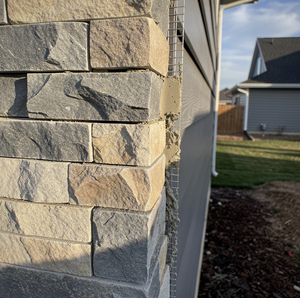
A contractor's quote comes back listing "stone veneer," and the wall in the rendering looks the same either way. But two very different products can produce that rendering: individual pieces set one at a time, or pre-assembled panels installed several square feet at once. The finished wall can look no different from the sidewalk. What differs is how it goes up, how a corner gets turned, and what happens the day a single piece gets cracked by a dropped tool or a stray baseball.
Individual Pieces or Pre-Assembled Units
Loose stone veneer is sold as individual pieces, cut or cast to a thin profile, boxed loose so an installer sets each one by hand. Every piece gets fitted against its neighbors like a puzzle, with the gaps either left as a mortar joint or tooled tight for a dry-stack look. The installer chooses which piece goes where as the wall goes up, blending color and shape by eye.
Panel veneer starts with the same stone stock, but a group of individual faces is bonded to a rigid backer at the factory, arranged in a fixed pattern. One panel might cover a couple of square feet on its own. Instead of setting dozens of loose pieces, the installer positions and sets a handful of panels, and the pattern designed into those panels repeats across the wall.
Format is separate from material: Both loose stone and panel veneer can be natural quarried stone or manufactured, pigmented concrete. The loose-versus-panel decision is about how the wall goes up, not what the stone is made from, and comparing natural to manufactured stone is a separate decision.
How the Look and Pattern Differ
A wall built from loose stone shows no repetition, because every piece was placed by hand against whatever sat next to it. Color variation reads as random, the way it would on a natural rock face, and a sharp eye can follow the mason's judgment call at every seam.
A panel wall repeats the pattern that was molded or assembled into each unit. Manufacturers stagger the panel design and vary the color blend across a production run specifically to fight that repetition, and a well-matched color blend keeps the seam between two panels from reading as a hard line under normal lighting. But line up two identical panels side by side under raking light, and the repeat becomes visible in a way loose stone never produces, since loose stone has no fixed unit to repeat.
How Each One Goes Up
Setting loose stone is a piece-by-piece masonry process. Each stone gets buttered with mortar or set into a bed, checked for level and reveal against its neighbors, and worked into the field one at a time, with the pace depending entirely on how much hand-fitting a given batch of stone needs.
Instead of setting one piece at a time, the installer butters the back of a full panel and presses it into the scratch coat, covering several square feet in one motion. Fewer individual units change hands either way, so a panel wall generally goes up faster than the same square footage in loose stone, though the panels still need to be planned out so the pattern lines up across seams.
Count corner pieces separately from flat panels: measure the height of every outside corner in linear feet, then add extra flat panel material for the cuts around windows, doors and outlets.
How Corners Get Handled in Each System
A flat panel cannot wrap around an outside corner on its own, because the backer is rigid. Both systems solve this with a dedicated corner piece: an L-shaped unit with two finished faces meeting at 90 degrees, alternating a long return leg and a short one, course by course, so the running bond lines up on both walls.
The difference shows up where that corner piece meets the field. With loose stone, the field pieces are individually fitted right up against the corner unit, so the transition blends as it would with any two adjacent loose pieces. With panel veneer, a full panel must butt against the corner piece, and an installer often has to trim or piece in a partial panel section so the seam lands cleanly against the corner return.
The Wall Behind Each System
Neither loose stone nor panel veneer is load-bearing, so neither requires the structural footing that a full-thickness stone wall would provide. Both are claddings that depend on the wall behind them being sound and properly protected from moisture.
Both formats go over the same weather-resistive barrier, lath, and scratch coat: a drainage layer, lath, and the mortar bed into which the material is set. Loose stone is mortar-set piece by piece into that bed. Panel veneer is buttered on the back and pressed into the same scratch coat in larger units, covering more of the wall with each piece placed. Some manufactured panel lines are designed to screw into furring strips rather than mortar, and the manufacturer's installation instructions for that specific product specify which method applies. Either way, the wall still needs a sound moisture barrier and correctly detailed flashing underneath, since neither a mortar bed nor a panel backer is a substitute for proper drainage.
Repairing a Damaged Piece Later
Repairs are where the two systems diverge once the wall is finished. A single loose stone that gets cracked or knocked loose can be removed and reset on its own, since each piece was always independent of its neighbors. The repair touches one spot and leaves the rest of the wall undisturbed.
A panel is a single bonded unit. Damage to one stone face within a panel means dealing with the whole panel section, because the individual stones are fixed to a shared backer and can't be popped out and reset the way a loose piece can.
Loose Stone vs Panel Veneer at a Glance
| Factor | Loose Stone Veneer | Panel Veneer |
|---|---|---|
| Look | No repeat; each piece placed by hand | Pattern repeats per panel; manufacturers vary the blend to hide it |
| Installation | Piece-by-piece, mortar-set, slower | Larger units set in mortar or screwed per product instructions, generally faster |
| Corners | Corner piece blends into hand-fitted field pieces | Corner piece must meet a cut or pieced-in panel edge |
| What the wall behind needs | Weather barrier, lath, and a mortar setting bed | Same weather barrier, lath, and scratch coat; some panel lines screw to furring instead |
| Repairs | Single piece removed and reset on its own | The whole panel section |
Which One Fits Your Wall
A large, flat elevation with a tight installation schedule is a good fit for panel veneer: fewer units to place and less individual hand-fitting across the field. A wall with a lot of custom cutting around windows, an irregular opening, or an outside corner on every side is a good fit for loose stone, since hand-fitted pieces can be trimmed and pieced individually to work around an odd shape, while a fixed panel arrives already sized and shaped at the factory.
The question worth asking before ordering either one is how the wall is likely to get damaged over its life and how much repair effort that damage should require. A wall where a single reset is an acceptable repair point points toward loose stone. A wall where the schedule and installation effort matter more than repairability points toward panels.
Frequently Asked Questions
Can a wall combine loose stone and panel veneer in the same project?
Yes. A clean way to hide the switch is to run the transition along a natural break, such as an inside corner, window trim, or a control joint, rather than stopping mid-field, where the two textures would sit side by side in plain view.
How is a stone panel cut to fit around a window or an outlet box?
With a diamond blade on a wet saw or an angle grinder, since the stone faces cannot be scored and snapped the way ceramic tile can. Cut edges are placed where trim, a corner piece, or a cover plate hides them, because a sawn edge is smooth and flat where the uncut stone is split and textured.
Do screw-fastened panel systems still need the same weather barrier as mortar-set panels?
Yes. A manufacturer's screw-to-furring panel line still requires the weather-resistive barrier and a ventilated air gap behind the furring strips, since the fastening method changes how the panel attaches, not whether the wall needs to shed water.
Are the mortar joints on loose stone veneer wider than the seams on panel veneer?
A mortared loose-stone joint is left open as a visible grout line, while a dry-stack or panel seam is set tight. Loose stone also gives an installer room to widen or narrow an individual joint by eye to work out an uneven stone size, a fine-tuning option a fixed panel seam does not have.
Does panel veneer come off differently than loose stone during a renovation?
Yes. A panel section comes off as a single bonded unit still attached to its backer, since freeing one stone face means freeing the entire panel behind it. Loose stone comes away piece by piece as the mortar is broken loose. That difference changes how much removal labor a wall generates and how much material ends up in the dumpster.
What does the base of a veneer wall need at grade?
What both loose stone and panel veneer need is clearance above grade or the adjacent paving at the base of the wall, to keep splash-back moisture off the bottom course.
See stacked stone panel samples in our showroom — bring your wall dimensions in for a material count. North Valley Stone Supply LLC serves Phoenix, Scottsdale, and Tempe. Call (623) 244-8657.