
Fire Glass vs. Lava Rock for a Fire Pit: Which Looks Better?
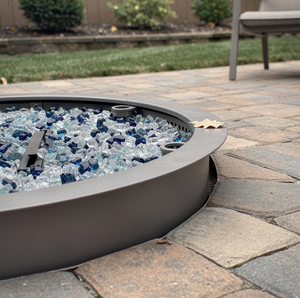
Fire glass and lava rock sit over the same gas burner and hide the same ports, but one is a manufactured product tumbled from tempered glass, and the other is a natural volcanic stone. That difference carries into how each one looks lit, how it looks cold, how it handles the flame, and how it holds up outdoors year after year. How the two fills compare over the same burner, lit and cold:
| What You're Comparing | Fire Glass | Lava Rock |
|---|---|---|
| The look, lit and unlit | Reflective or color-through pieces that catch and bounce the flame's color when lit, and read as a smooth, uniform bed of glass in daylight | A rough, natural texture in reds, blacks, and grays that looks about the same lit or unlit, since it doesn't reflect light the way glass does |
| How it sits over the burner | Loose, rounded or angular pieces that settle into an even layer | Irregular, porous chunks that interlock and hold their arrangement |
| Heat and flame behavior | Smooth facets scatter the flame's light across the bed; both fills stay hot after shut-off, so let either cool first | Matte surface keeps the light on the flame itself; both fills stay hot after shut-off, so let either cool first |
| Color choices | Wide range, from clear and blue to black, in reflective or color-through finishes | Natural reds, blacks and grays |
| Cleaning | Rinses clean with a hose; a full soak works for stuck-on residue | Rinses too, but the porous texture can need a longer soak to lift grit |
| Use with gas or wood | Manufactured and rated for gas fire features only, never a wood-burning fire | Natural stone used as burner fill in gas fire features |
What Each Material Is
Fire glass begins as ordinary tempered glass, crushed or tumbled into rounded or angular pieces small enough to sit in a shallow bed over a burner without blocking it. Some pieces carry their pigment straight through the glass itself; others carry a thin reflective coating bonded onto a clear or lightly tinted piece for extra shine when the flame hits it. Tempered glass shatters into small, blunt chunks rather than long shards, which is where fire glass gets its size. Tumbling then rounds each piece's edges for handling once it has cooled.
Lava rock is a naturally occurring, porous volcanic stone, mined and sized rather than manufactured. Its rough surface and irregular shape come from how it cooled after forming, not from any process applied afterward, and its color sits in the stone itself in reds, blacks, and grays rather than in a coating or a dye.
Only glass made and tempered for fire features belongs over a burner; ordinary decorative glass and stone that has soaked up water can crack or pop when heated.
The Look: Reflective Color vs Natural Rough Texture
Fire glass changes character with the flame on or off. Lit, a reflective piece throws the fire's color back at the viewer and can make a modest burner look like a larger fire than it is; unlit, the same bed reads as a flat, uniform field of glass, muted without the flame lighting it from within. Color-through glass maintains the same color whether lit or unlit, since its color is mixed into the material itself rather than sitting only on a reflective surface.
Lava rock doesn't shift the same way between lit and unlit. Its rough, matte surface doesn't reflect light, so a lit pit shows the flame itself more than it shows the rock underneath, and the rock looks about the same in daylight as it does at night with the burner off. That steadiness reads as more natural to some yards and less dramatic to others, depending on the effect the space is going for.
How Each Works With the Flame
The burner sets the flame's shape and size; the fill changes how that light gets seen. A bed of smaller pieces packs more faceted faces into the same area, so it throws back light from more points. Lava rock's porous, matte surface absorbs more of that light rather than reflecting it, so the same flame over lava rock reads as a plainer, steadier glow centered on the fire itself rather than spread across the fill.
If you ever smell gas near the fire feature, stop and shut off the gas at the valve, then have a licensed technician check the line before lighting it again. Never troubleshoot a gas smell yourself.
Weathering and Upkeep
A reflective coating on fire glass is a thin layer bonded to the glass, so under intense, unbroken sun, that finish is the part of the bed that can visibly weather; lava rock and color-through glass have no separate layer to lose, since their color sits in the material itself. Where the sun is milder, the change stays slight on any fill, and a finish can be picked on looks alone.
Cleaning calls for different routines. A garden hose and a soft brush lift loose residue from either fill; buildup the hose leaves behind calls for pulling the fill out of the pit for a deeper clean.
Mixing Them: A Lava Rock Base Under a Fire Glass Top Layer
Some fire pits use a hybrid fill: a base layer of lava rock closer to the burner, topped with a shallower layer of fire glass for added shine and color. The rock underneath fills out the bed, while the glass on top does the visual work the flame plays across. The rock fills the pan up to the burner, and the glass on top supplies the layer over the ports. The color itself gets built in at different points in the process. A color-through piece has its pigment mixed into the glass while it is still molten, so the color runs the same way through once it cools and is cut into pieces. A reflective piece starts as that same molten glass, but its shine comes from a coating applied afterward, once the piece has already been shaped and cooled, laid onto the surface rather than mixed into the batch. That separate step is why a reflective piece can start as clear or lightly tinted glass and still end up in a wide range of finish colors.
Lava rock's pores can hold water after its surface looks dry, so give a rinsed piece extra time to dry through before it goes back over a burner or under a fresh layer of fire glass.
Check that your burner's instructions allow a mixed fill, since a layered bed still has to clear the ports at whatever combined depth it settles to.
Matching the Fill to Your Pit and Yard
A modern, minimal yard favors fire glass, especially in a reflective finish, since the material's shine and color range do more visual work in a simple, clean-lined pit. A yard with a natural, rock-garden feel, especially one already built around stone and pebble beds, reads better with lava rock or a mixed fill, since the rock's texture and muted color sit closer to the rest of the hardscape.
Feature type plays a role too. A shallow fire bowl shows off a reflective fill more than a deep, enclosed pit does, since more of the fill's surface stays visible from a seated sightline. A taller-walled pit hides more of the fill regardless of material, which shifts the decision toward upkeep and heat behavior rather than toward the visual effect either one gives off.
Frequently Asked Questions
Is either fill safe to touch soon after the burner shuts off?
No. Both sit in the flame and stay hot after the gas is off, so either bed is left to cool completely before anyone reaches in, rinses it, or tops it up. Lava rock's porous structure retains heat throughout the piece.
Does a lava rock base weigh less than filling the same depth with fire glass?
Yes. Lava rock is a lighter, more porous stone than dense fire glass, so a base layer of it under a fire glass top layer uses less material weight than filling that same depth with glass alone.
Can lava rock come in colors, or is it only its natural tone?
Lava rock's natural range runs to reds, blacks, and grays, but some suppliers tint or coat lava rock for a wider range of shades. That color sits on the surface of the stone rather than running through it the way color-through fire glass does.
Is it safe to switch from lava rock to fire glass in the same fire pit?
Yes, since both sit as a loose fill rather than being fixed to the pan, so switching means emptying one and filling with the other. The two fills differ in piece size, so the new one gets poured to its own depth rather than to the line the old fill left.
Does lava rock wear out the way fire glass discolors?
Years of direct flame exposure can pit a lava rock's surface and crumble the edges of individual pieces, since it's a natural stone rather than a manufactured, heat-tempered product.
Does dust or blown debris show up more on one material than the other?
Lava rock's rough, porous surface can keep fine dust and pollen out of sight, since there is less reflective surface to catch the eye. On fire glass, the same debris shows up against the smooth, reflective pieces until it is rinsed off.
Ask about fire glass colors and cuts for your fire pit — color-through and reflective fire glass in cuts sized to sit over a gas burner. North Valley Stone Supply LLC serves Phoenix, Scottsdale, and Tempe. Call (623) 244-8657.