
Filled or Unfilled Travertine Pavers: What the Holes Mean
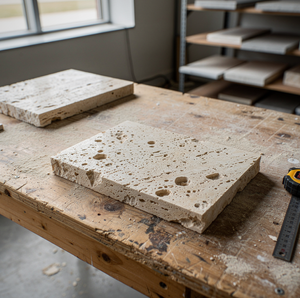
Travertine forms around mineral springs, where gas bubbling up through the rock and water moving through it leave voids scattered through the stone as it hardens. Cut that stone into a paver and some of those voids land right on the face, showing up as small pits and pockets of different sizes and depths. Every travertine paver carries this, because it comes from how the stone itself formed, not from a flaw in any one piece. The buyer's choice is whether those holes arrive open or closed: a quarry or finishing plant can leave the holes as they are or fill them before the paver ever reaches a yard.
That single choice changes how the paver looks, how it feels underfoot, what collects on its surface outdoors, and how it takes a seal. The comparison pairs filled and unfilled travertine across the points that matter to a buyer standing between two pallets.
| Factor | Filled Travertine | Unfilled Travertine |
|---|---|---|
| Surface look | Flat, closed face with tinted fill visible in the voids | Open pits and pockets across the face |
| What collects in the holes | Nothing open to collect; the fill closes the void | Dirt, debris, and standing water after rain or a hose-down |
| The fill and how it wears | A resin or cement-based filler set into the void; can shrink or work loose over time | No fill to wear; the void itself stays as cut |
| Sealing | Seals over a face closed at each filled void | Seals over a face still open at each hole |
| Feel underfoot | Smoother, more continuous surface | Textured, with small dips at each open hole |
| Where each fits | Pool decks, patios and walkways where a closed, easy-to-sweep face is wanted, in a finish chosen for grip | Patios, walkways and pool decks where a natural, textured face is wanted |
What the Holes Are and Why Every Travertine Has Them
Travertine is a form of limestone that builds up in layers as mineral-rich water deposits calcium carbonate around a spring. Gas escaping through that process, along with water moving through the forming stone, leaves gaps that get sealed into the rock as more layers build on top. By the time a block is quarried and cut into tile or paver thickness, those old gaps are exposed on the cut faces as holes of different sizes, from a pinprick to a pocket you could rest a fingertip in. A face with no visible holes has been filled, or was cut from an unusually dense block.
The holes sit in the same layer as the surrounding stone and are part of it as quarried, not cracks or flaws. What they change is what happens on the surface: an open hole is a place for water, dirt, and grit to sit, while a closed one is not.
How Factory Filling Is Done
At the plant, each void is closed with one of two filler types: a resin-based filler or a cement-based filler, tinted to match the surrounding stone's tone. A resin filler cures through a chemical reaction, while a cement-based filler cures as it dries and hardens. The filler is worked into the open pit, leveled with the surrounding face, and cured before the paver is cut to final size and finished. A filler left proud of the surrounding stone gets ground flush with the surrounding stone during finishing, while one that sits low leaves a shallow dip that still traps grit.
That fill is a separate material bonded into a natural void, and it can behave differently from the surrounding stone over the years. Sun and moisture reach the fill the same way they reach the stone, and a resin or cement fill does not always expand and contract at the same rate as the surrounding limestone. Over time, that mismatch can let a filled spot shrink slightly at its edge, lose its bond to the stone, or work loose from the paver entirely, leaving a small gap where a smooth face used to be. This does not happen to every filled hole on a patio, and it says nothing about the stone underneath; it is a property of the fill material bonded into the void, not of the travertine.
Unfilled Travertine Outdoors
Leaving the holes open keeps the paver in the state it left the quarry: every pit is a true void, with nothing bonded into it to shrink, discolor, or pop loose later. That is the appeal for a buyer who wants the stone's natural texture on full display.
Outdoors, an open hole is also a place for things to settle. Dirt tracked across the surface, wind-blown grit, and rainwater that has not yet run off can sit in a pit until it is cleared. A broom or a hose across the surface lifts loose debris out of the shallow holes; deeper pockets can hold on to fine grit longer and may need a stiffer brush worked into them. A shop-vac's narrow nozzle reaches into a deep pocket that a broom's bristle head just passes over, so the tool that clears a shallow hole is not always the one that clears a deep one. None of this changes the stone itself. It is housekeeping on a textured surface, the same kind of upkeep any textured natural stone asks for.
Finish and Fill Together
Travertine pavers come in finishes such as tumbled, brushed, or honed, and any of those finishes can be paired with either filled or unfilled stone. A tumbled face has already had its edges and surface softened before the fill decision is made, so a tumbled-and-filled paver still reads more casual than a honed-and-filled one, even though both are closed at the surface. Honed travertine is ground flatter and smoother than tumbled travertine, and a honed finish paired with an open hole creates a sharper contrast between the flat face and the pit than a tumbled finish does.
Grip underfoot when wet depends on the chosen finish and fill: a tumbled or brushed face retains more texture in either state, while a honed, closed face becomes slicker when wet.
Sealing Each One
Both filled and unfilled travertine take a sealer, but the surface the sealer meets differs: a face sealed at each void in filled stone versus an open, more porous face in unfilled stone. Cleaning, drying, and applying that sealer correctly is its own process with its own failure points, and it is the same process for either kind of travertine once the surface is prepped.
Acid etches travertine, filled or not, because the stone is calcium-based, and an acid cleaner dulls whatever face it touches. A pressure-washer stream held close can dig out fill from a void, so distance and a low setting protect it.
How to Choose with a Sample in Hand at the Yard
A photo or a swatch card does not show what a filled hole looks like next to an open one, or how the two feel under a bare foot. The difference reads clearly once a piece of each is on the counter side by side: run a hand across both faces, tip them under the light to see how the fill sits versus how the open pits catch a shadow, and set a foot on each if the setting allows it. Bringing the finish into the comparison at the same time, tumbled next to honed, filled next to unfilled, narrows a full catalog down to the handful of combinations that fit a pool deck, a covered patio, or a walkway, and staff at the yard can walk through which combination suits the spot in mind.
Frequently Asked Questions
Can a filled hole be fixed if the fill works loose after the paver is installed?
Yes. A loosened or shrunk fill spot on one paver is a local repair, not a reason to redo the surface: a mason can clean out the old fill and set a fresh, matched filler into that one void without touching the pavers around it.
Is there a quick way to tell filled and unfilled travertine apart before buying?
A fingernail drawn across the face catches at an open hole; over a filled one it passes flush unless the fill has shrunk at its edge.
Does the factory fill match the stone's color exactly?
Not exactly. The filler is tinted toward the stone's base tone, and up close it can show as a slightly different texture or tone where the hole was.
Can an open hole in unfilled travertine get larger over time?
It can. A thin shell of stone over a hidden void can break under traffic, opening a new or larger hole, and an edge can chip where something with a hard corner is dragged across it.
Does filling the holes change a paver's weight?
Only by the filler held in the voids; the stone's size and thickness set the rest of the paver's weight.
Can unfilled travertine be filled after it is laid?
Yes. A mason can work a grout or filler into the open holes after the pavers are set, one void at a time, and that hand fill is a separate material from a factory fill.
Order filled or unfilled travertine pavers — staff at the yard match the fill and finish to your pool deck, patio, or walkway plan, with pickup or delivery to the job site. North Valley Stone Supply LLC serves Phoenix, Scottsdale, and Tempe. Call (623) 244-8657.